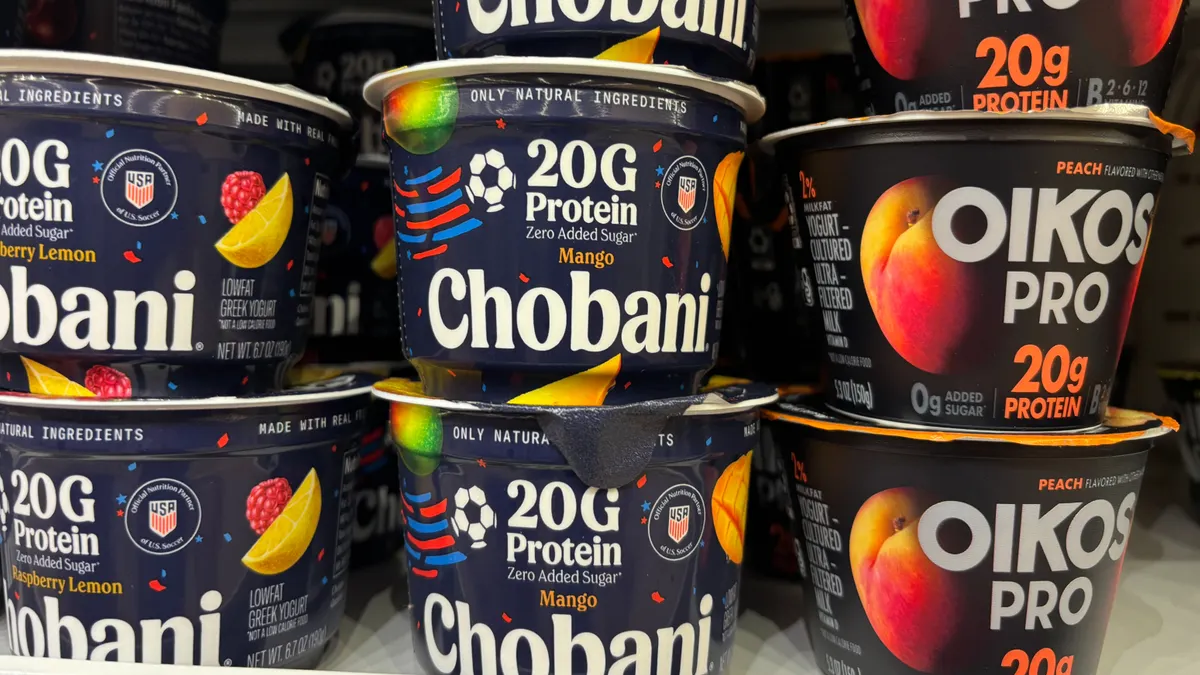
Danone sued Chobani, alleging its archrival is misleading consumers over how much protein is included in a serving of its high-protein yogurt.
The food giant said on Monday that Chobani is manipulating the serving size on its 32-ounce containers of Chobani 20G Protein to inflate the protein content. Danone alleges that in order to claim 20 grams of protein per serving, Chobani sets its serving size at 6.7 ounces instead of the industry standard of 5.3 ounces.
The inflated serving size is found in Chobani's single-serve yogurt cups and the 32-ounce multiserve tubs, according to Danone. However, the lawsuit said that unlike single-serving containers, multiple-serving containers are subject to FDA rules governing the calculation of serving sizes.
If Chobani followed the FDA’s serving-size rules for its 32-ounce containers, the lawsuit said, it would be able to claim only 18 grams of protein per serving — below the key 20-gram threshold for high-protein yogurts.
Danone argues that changes to serving size lead shoppers into thinking that Chobani's yogurt has a similar amount of protein as Danone’s Oikos Pro, the company's ultra-high protein line. Instead of developing a product of comparable protein density, Danone said Chobani “chose to engage in unfair competition and consumer deception.”
“If the Chobani Product were truthfully named, labeled, and marketed, consumers would not see it as a viable alternative to Oikos Pro in the ultra-high-protein yogurt category,” Danone said in the lawsuit, filed on June 15 in the Southern District of New York. “Chobani’s deceptive conduct makes consumers perceive it as a legitimate alternative in that category — thereby siphoning away protein-conscious customers who would otherwise have purchased Oikos Pro.”
Protein has become hugely popular among consumers, with 70% of shoppers saying they aimed to increase their protein intake in 2025, according to the International Food Information Council. Four in 10 consumers said they look at "grams of protein per serving" most often when scanning packaging, making the claim an important part of purchasing decisions.
Food manufacturers have raced to include protein in mainstream products such as Pop-Tarts, Kraft Mac & Cheese and Doritos. But yogurt, which already contains significant amounts of the nutrient, has been one of the biggest beneficiaries of the protein boom. Danone said last fall it was struggling to meet demand for its high-protein yogurts due to a lack of manufacturing capacity in the U.S.
Danone said in the complaint that manufacturing dairy products with 20 or more grams of protein per serving is “difficult and costly,” requiring spending on state-of-the-art technology, customized production facilities and innovative recipes.
"To make up for this shortcoming in technology and know-how, Chobani has relied on consumer deception to elbow its way into the ultra-high-protein yogurt market," Danone claimed.
Danone is seeking unspecified damages and also asking a court to force Chobani to change its advertising and give up profits tied to the allegedly mislabeled yogurt.
Chobani did not respond to a request for comment.
“Chobani’s deceptive naming, labeling, and advertising has caused — and, unless curtailed, will continue to cause — substantial harm to Danone US and to unwitting consumers,” Danone said.
This is Danone's latest lawsuit against Chobani as food manufacturers look for any advantage they can get in a competitive market where consumers are pulling back on spending due to inflation. Last July, Danone sued Chobani over its La Colombe cold brew, saying the packaging and slogan is similar to the French dairy giant's Stōk coffee.