Policy: Page
-
DC's proposed excise tax could hike prices of soda and other sugary drinks
Council members are weighing a 1.5 cent-per-ounce duty on sweetened beverages, which would add about $1 to the price of a 2-liter bottle.
By Cathy Siegner • Oct. 9, 2019 -
Union sues to stop pork industry from having more power over inspections
The United Food and Workers Commercial Union said the new plan, which went into effect Oct. 1, jeopardizes consumer health and the safety of factory workers.
By Jessi Devenyns • Oct. 8, 2019 -
 Explore the Trendline➔
 Courtesy of Instacart
Trendline
Courtesy of Instacart
TrendlineTop 5 stories from Food Dive
Check out a selection of articles about some of the biggest trends and news — from McCormick’s reformulation strategy to the impact of GLP-1s — shaping the food industry in 2026.
By Food Dive staff -
 U.S. Department of Agriculture. (2011). [photograph]. Retrieved from https://www.flickr.com/photos/usdagov/5707774275.
North American Meat Institute sues California over animal confinement law
NAMI's lawsuit claims Proposition 12 is unconstitutional and will "hurt the nation's food value chain by significantly increasing costs for producers and consumers."
By Cathy Siegner • Oct. 8, 2019 -
Opinion
What the food and beverage industry needs to know about CBD
Although federal and state laws are evolving and inconsistent, three lawyers break down five concrete lessons for stakeholders based on a snapshot of the regulation today.
By Anita Sabine, Jessica Borowick and Jeff Edelstein • Oct. 7, 2019 -
How a 25% tariff on food and beverage from the EU will impact the US
Products to be taxed as part of a dispute about aircraft subsidies include single-malt whiskey, olives, butter, cheese and olive oil, with most coming from France, Germany, Spain and the U.K.
By Cathy Siegner • Oct. 4, 2019 -
Only 3% of agri-food tech investment dollars go to female-founded companies, study says
Investors also hold women to higher standards to justify their plans and need for funding, according to the report from AgFunder, Karen Karp & Partners and The New Food Economy in collaboration with S2G Ventures.
By Jessi Devenyns • Oct. 4, 2019 -
Why the pork industry should target Latinos
These consumers, who represent almost $1.7 trillion in purchasing power, may gravitate to other protein sources if they can't get appropriate products for their traditional recipes, according to a report from the National Pork Board.
By Cathy Siegner • Oct. 3, 2019 -
Red meat isn't unhealthy after all, new study says
An international research team found no evidence to support reducing the popular protein in diets, but some advocates disagree, leaving consumers unsure what to believe.
By Cathy Siegner • Oct. 2, 2019 -
 FDA
FDA
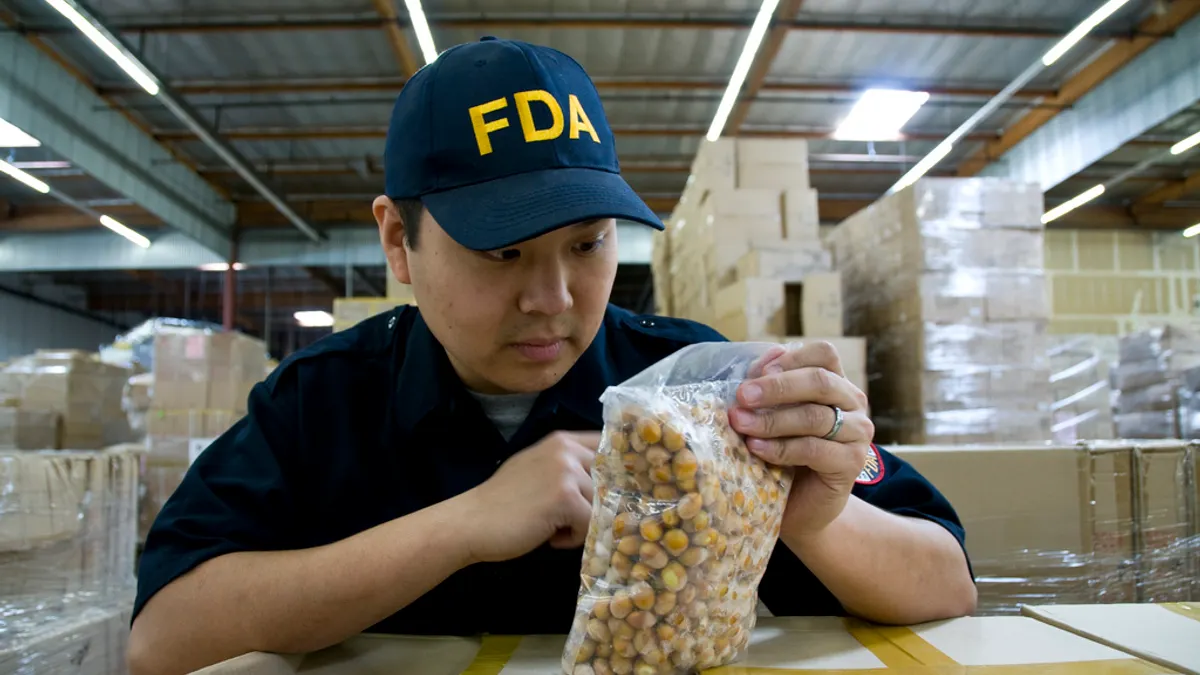
FDA launches FSMA compliance dashboard
The agency will update the data quarterly with the eventual goal of tracking compliance for all seven rules in the 2011 law and identifying broader trends.
By Jessi Devenyns • Oct. 1, 2019 -
How should FDA modernize food standards of identity?
Guidelines were created during the last 81 years "to promote honesty and fair dealing," but many say they currently stifle innovation.
By Lillianna Byington • Sept. 30, 2019 -
Why is fresh fruit putting the squeeze on fruit juice?
The beverages have high sugar content and can be linked to health problems, but consumable produce can have the same issues.
By Cathy Siegner • Sept. 30, 2019 -
Study: Consumers still eat too much sugar, starch and saturated fat
Researchers found that, from 1999 to 2016, U.S. adults got 42% of their energy intake from low-quality carbs.
By Cathy Siegner • Sept. 26, 2019 -
US, Japan sign trade deal to lower tariffs on agricultural goods
Japan will lower or eliminate tariffs on agricultural imports from the U.S. worth $7.2 billion, potentially helping U.S. export supply chains that have suffered amid recent trade conflicts.
By Cathy Siegner • Updated Oct. 8, 2019 -
What caused E. coli outbreaks in Arizona lettuce? A new research initiative will investigate
The multi-year initiative of the FDA, University of Arizona and local growers will study environmental factors and how they contribute to contamination.
By Cathy Siegner • Sept. 24, 2019 -
Food companies lead the charge to increase biodiversity
The 19 global companies forming One Planet Business for Biodiversity pledge to have definitive proposals to stop the loss of smaller crop species by October 2020.
By Cathy Siegner • Sept. 24, 2019 -
Lawmakers press FDA to act on CBD regulations
Congress is pressuring the agency to adopt rules clarifying the legal and regulatory framework for CBD as a food additive and dietary supplement.
By Cathy Siegner • Sept. 23, 2019 -
Industry should advocate for Trump's trade and immigration reforms, says USDA head
The president is agriculture's "best advocate," Sonny Perdue told attendees at the United Fresh Produce Association's Washington Conference.
By Lillianna Byington • Sept. 19, 2019 -
Consumers are confused about sustainable diets, survey finds
Two-thirds of respondents to the study by the International Food Information Council Foundation said protein from both animals and plants can make up a diet that is good for the environment.
By Cathy Siegner • Sept. 18, 2019 -
A think tank predicts beef and dairy will collapse in 11 years. Is it right?
RethinkX said as technology to produce these products in a lab gets better and less expensive, demand for items from cows will plunge 70% by 2030.
By Megan Poinski • Sept. 18, 2019 -
Are big CPG companies getting serious about reducing plastic packaging?
Nestlé's new research institute will devise more environmentally friendly solutions, and PepsiCo plans to reduce the amount of virgin plastic in its beverage containers by 2025.
By Cathy Siegner • Sept. 16, 2019 -
What's in a name? Research looks at the best ways to describe lab-grown meat
"Cultivated meat" might be the best term to describe products made in a lab from animal cells, according to research unveiled at the Good Food Conference.
By Cathy Siegner • Sept. 16, 2019 -
Organic cheerleaders optimistic as growth in popular category slows
Panelists at Expo East spoke about the segment that has posted a growth rate of 5.9% in 2018 compared to increases of 6.4% a year earlier and 12.2% in 2013.
By Christopher Doering • Sept. 13, 2019 -
How treatment that could reduce peanut allergies might change food
Researchers found small doses of liquified nut protein under the tongue could increase children's tolerance of the legume.
By Cathy Siegner • Sept. 12, 2019 -
StarKist hit with maximum $100M fine in tuna price-fixing case
In addition to the financial penalty, a federal judge in California put the company on 13 months of probation for conspiring to set U.S. prices.
By Cathy Siegner • Sept. 12, 2019 -
Mississippi considers changes to plant-based meat labeling law
The state's new rules would allow manufacturers to comply with its ban on meat-based terms by using a "comparable qualifier" on packages such as "meat free" or "made from plants."
By Cathy Siegner • Sept. 10, 2019
 Previous