
Consumer confidence in food safety reached a record low in 2024 due to food recalls and increased reporting on toxic ingredients, according to the International Food Information Council (Ref. 1), making it more important than ever for companies in the food and beverage industry to guarantee the safety of their products. Modeling and simulation allow companies to optimize their food testing, sterilizing, heating and packaging processes, all while minimizing waste. Keep reading to see three compelling industry examples.
1. Food sterilization assessment
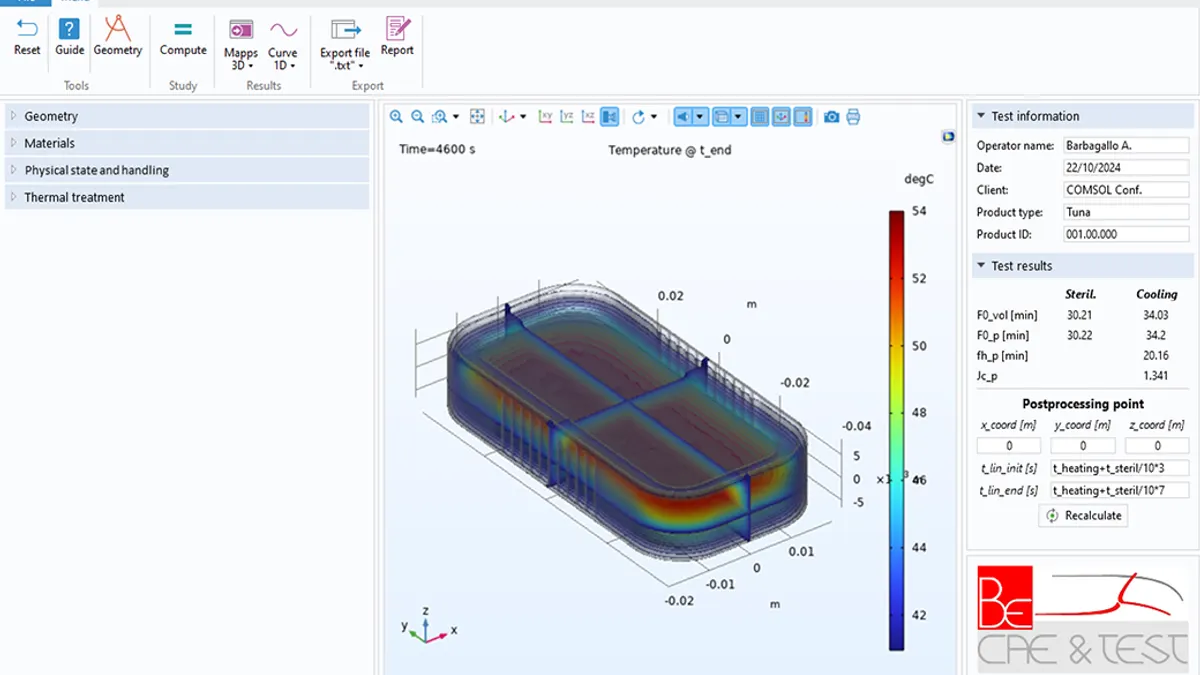
Through sterilization, effective heat penetration destroys harmful bacteria in consumers’ food. BE CAE & TEST, an engineering consulting firm in Italy, developed a custom simulation app using the Application Builder in the COMSOL Multiphysics® software that assesses the effectiveness of heat penetration inside canned food during sterilization to evaluate bacterial lethality. Their app helps food engineers to conduct canned food safety analyses using accurate physics-based models — without having to learn how to use simulation software.
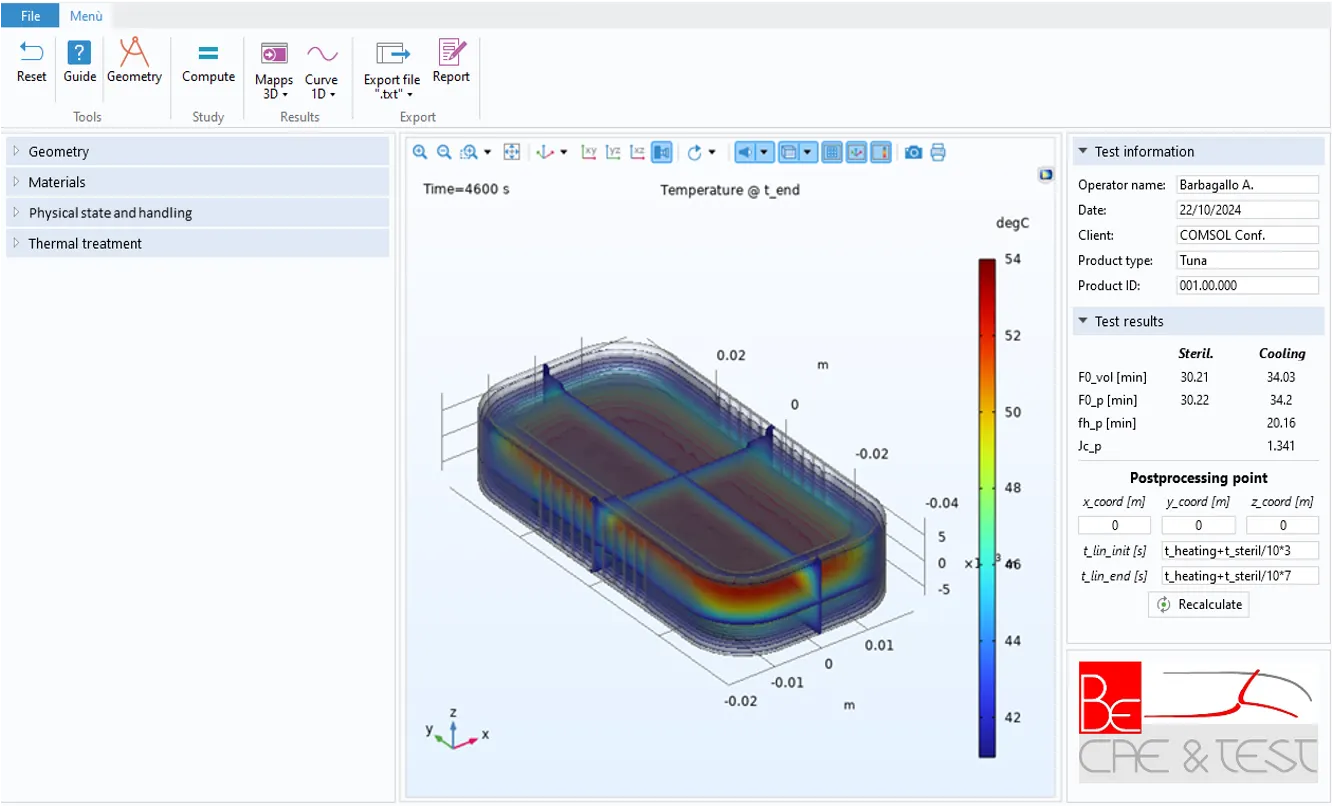
By entering relevant data in the custom input fields, food engineers can use the app to calculate temperature changes over time during transient analysis. This allows them to determine how heat penetration affects bacterial lethality in various canned goods. Bolstered by this information, they can then optimize food sterilization processes and reduce the risk of harmful bacteria entering our food.
2. Optimizing pasta drying conditions
The pasta drying process involves a series of time- and energy-consuming trials aimed at identifying the optimal way to produce a consistent and high-quality product. The world’s largest pasta producer, Barilla, collaborated with the University of Calabria in Italy to develop a model to predict temperature, moisture distribution and structural changes during the drying process. Their model is used for optimizing drying processes to ensure product quality and minimize energy use.
The model predicts the temperature and moisture distribution during the drying process in turbulent air conditions. To represent a “tortiglione” piece of pasta, the team used a 2D geometry in their simulations. Overall, the team’s simulation predictions yielded a mean relative error of less than 9% when compared to the real-world results of the drying process.


3. Analyzing liquid food package degradation
Packaging for liquid food must safely preserve its contents without degrading. A team at Tetra Pak, the world’s leading food processing and packaging solutions company, modeled package material to optimize this. By simulating the material's response during induction heating, they learned how different attributes affect the material behavior of the packaging. Specifically, they used multiphysics couplings to determine how the drying of the paperboard was affected by the internal gas pressure and the varying dryness level across the packaging. Their simulations showed that a higher initial moisture ratio and a lower density resulted in less degradation due to moisture, which showed good agreement with their experimental data.

Multiphysics modeling supports food safety
Here we saw three examples of how engineers from the food and beverage industry use multiphysics modeling and simulation apps to analyze and optimize products and processes related to food safety. Of course, this list only scratches the surface of what you can model in this area. For more inspiration, check out our Food and Beverage industry page.
Reference
-
Consumer confidence in food safety hit a record low in 2024. (2024, September 19). International Food Information Council. https://ific.org/media-information/press-releases/food-safety/.
This article is an abridged version of the COMSOL Blog post “5 Real-World Examples of Modeling and Simulation for Food Safety”. For more information, please refer to the blog post here.