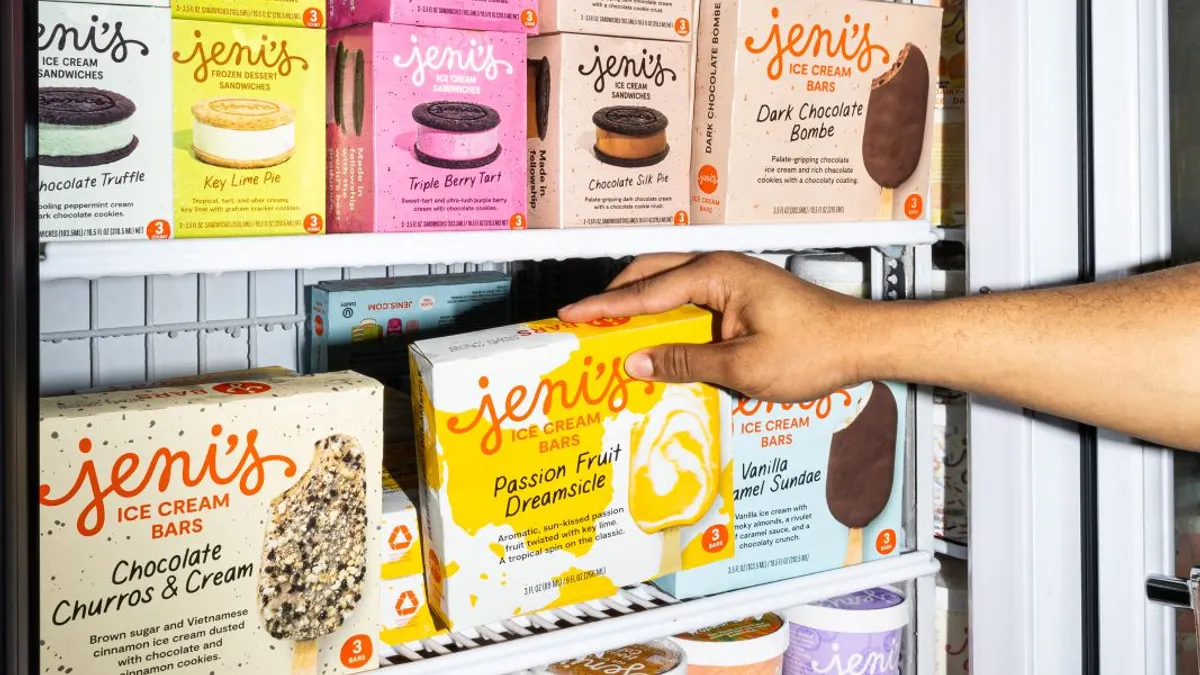
Jeni’s Splendid Ice Creams, one of the pioneers of artisanal ice cream in the U.S., is benefitting from surging demand for premium ice creams as cash-strapped consumers seek small indulgences.
A pint of Jeni’s retails on average for about $8.99, making it a more premium ice cream choice compared to private label brands that retail from around $3 to $5. Despite the higher price point, Jeni’s household penetration rose 46% year over year in the 52 weeks ending in April, according to NIQ data cited by Jeni’s.
“There’s a lot of economic uncertainty out there, and consumers are placing more emphasis on value,” said Scott Hargrove, chief marketing officer at Jeni’s. “What we’re seeing [consumers] not changing is those smaller luxuries, making time for intentional indulgence and premium brands.”
Jeni’s was founded in 2002 as a retail ice cream store in Columbus, Ohio, and found a cult following because of its unique flavors — including strawberry pretzel pie, watermelon taffy and wildberry lavender. It expanded to wholesale, grocery and other retail stores in 2009.
The ice cream stores, which the company refers to as scoop shops, still make up the bulk of its business at roughly 55%, but about 35% of the business is in wholesale, a segment that is still expanding. The other 10% is e-commerce.
When it comes to flavor innovation, Jeni’s tries to balance the unique flavors it's known for with more traditional varieties with a reimagined twist. Though Jeni’s has a dedicated group of fans, the brand still has what Hargrove called a modest awareness compared to more established brands. The company has invested in more marketing efforts on a local level and through collaborations, including with television series “Bridgerton” and “Ted Lasso” and musician Olivia Rodrigo. Jeni’s has also expanded its seasonal flavor drops.
Jeni's has seen grocery store sales grow since the onset of the COVID-19 pandemic. But in the last 18 months, momentum has accelerated thanks to the phenomenon Hargrove calls “intentional indulgence.”
As consumers become more intentional with their spending, they're turning to small treats and experiences while delaying larger purchases. One in six consumers planned to treat themselves more with premium food and drink products, according to an Innova study in 2024, with the trend most pronounced among Generation Z and Millennials.
“We as a brand take that [premium indulgence] to sort of another level, given our credentials around quality, creativity and experience,” Hargove said. “It’s benefiting the entire category, but I would argue that we are uniquely positioned to benefit even more.”
On the grocery store shelf, Jeni’s competes with other premium ice cream brands, including Van Leeuwen and Tillamook, which retail at a similar price. The overall premium ice cream market was valued at $21.56 billion in 2025, and is expected to reach $38.96 billion in 2033, according to Databridge Market Research.
In that environment, Jeni’s positions itself as a female-focused maverick brand that differentiates itself from other ice cream brands that focus on family tradition. But core to Jeni’s growth strategy is its ability to not bite off more than it can chew, Hargrove said.
“I do think it’s a big part of what makes the brand special, and why we’ve had such consistent compounding growth is that we don’t lurch,” he said. “We’re very thoughtful about our big strategic growth decisions, and how we bring the brand to life.”
Though wholesale is growing, Jeni’s remains strategic about the retail partnerships it pursues. It’s available in Kroger and Albertson’s, as well as specialty grocers including Whole Foods.
“We're fully committed to being a multi-channel business,” he said. “Wholesale clearly has a ton of opportunity, and wholesale acceleration will be a big theme for the organization going forward.”