
Dive Brief:
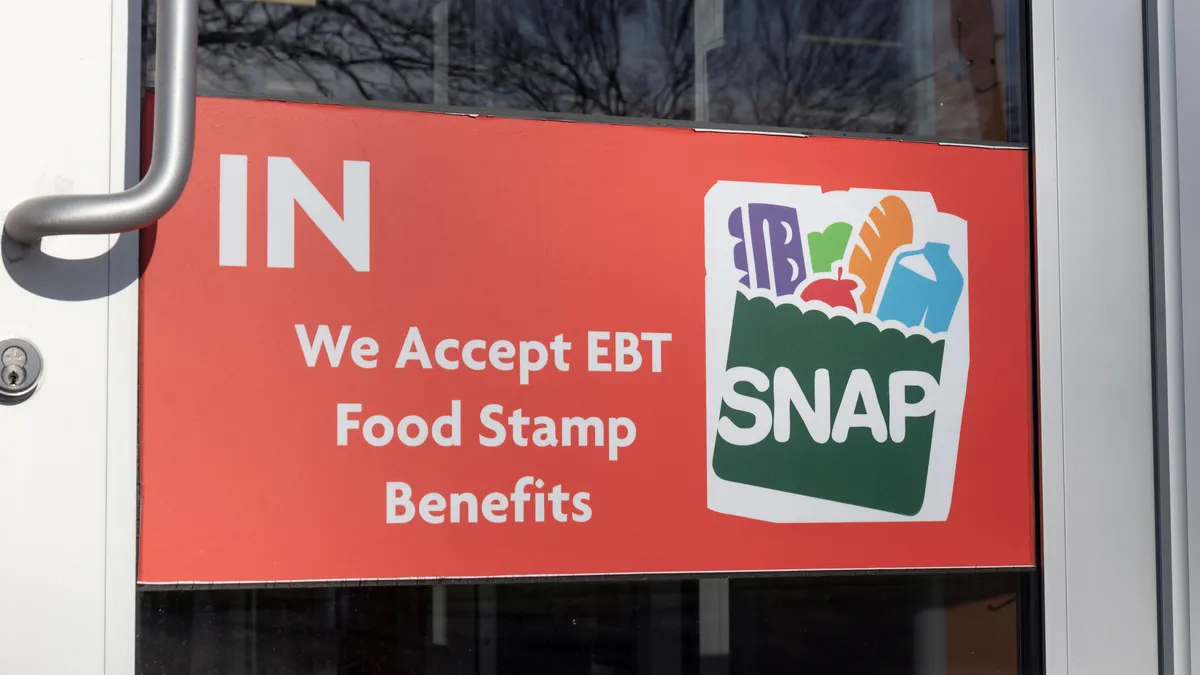
- A federal district court judge ruled Monday that the USDA exceeded its legal authority when it approved state-specific waivers that restrict certain foods such as candy and soda from SNAP.
- The ruling comes after several SNAP participants residing in Colorado, Iowa, Nebraska, Tennessee and West Virginia — all states that have received USDA approval for SNAP waivers — sued the USDA in March.
- The waivers violate a federal law’s definition of “food” for the SNAP program, wrote Judge Amy Berman Jackson of the U.S. District Court for the District of Columbia.
Dive Insight:
Food companies have been closely watching for the prospect of SNAP restrictions, which threatens to dent sales at a time where consumption is already on the declining. States implementing restrictions on SNAP spending by the end of 2026 could see an approximately $830 million sales loss in the categories targeted by the waivers, according to research from Numerator.
Proponents of the waivers, who include Health and Human Services Secretary Robert F. Kennedy Jr., claim they will help ensure that SNAP funds are not used to buy highly processed foods. However, in her ruling, Jackson made it clear that she was not weighing in on whether waivers could meet state goals of addressing health and nutrition concerns.
“The Court’s analysis should not be taken as a comment on whether the pilot projects are a good idea or not. That is a question of policy that is not before the Court,” Jackson wrote.
The USDA said in an emailed statement that it will continue efforts under the “Make America Healthy Again” movement.
“The idea that taxpayer funds should not be used to purchase junk food should not be controversial,” the USDA said. “USDA will not be backing down from the fight to Make America Healthy Again, including for families and communities reliant on SNAP.”
In a post on X, USDA Secretary Brooke Rollins railed against the ruling. “Taxpayers shouldn’t subsidize junk food and drinks at the expense of American health,” she wrote.
An activist judge just blocked our commonsense restriction on using SNAP benefits for soda and junk.
— Secretary Brooke Rollins (@SecRollins) June 23, 2026
SNAP is for food — not sugar bombs fueling obesity, diabetes, and skyrocketing healthcare costs for low-income families.
Taxpayers shouldn’t subsidize junk food and drinks at…
Where the state waivers go astray legally is that they are trying to exempt certain food and drinks — often candy and soda — from the Food and Nutrition Act’s definition of “food,” Jackson found. When approving the waivers, Rollins did not have the authority to bypass or exempt this definition, Jackson ruled.
“Congress defined what ‘food’ is supposed to be, and it did not authorize the agency to amend or waive the definition it enacted,” the judge wrote. “It did not authorize the agency to cut types of food out of SNAP entirely.”
Jackson noted in her ruling that the USDA has congressional authority to test certain types of projects aimed at improving health and nutrition through SNAP. But she found that the USDA did not rely on that section of federal law, which has strict requirements, to greenlight the state waivers.
Instead, the USDA relied on a different section of federal law, justifying the waivers as a way to “increase SNAP efficiency”; however, the judge found that “none of the state plans or USDA approvals indicate that the pilot projects might ‘increase the efficiency’ of the SNAP program within the meaning of the statute.”
For the state waivers, the USDA also didn’t follow requirements that it post notice of major pilot projects in the Federal Register 30 days before implementation, Jackson found.
Jackson vacated the approval of the five state restrictions and said that the USDA “will have to go back to the drawing board to design pilot projects that accord with [federal law].”
The Food Research & Action Center, a nonprofit focused on poverty-related hunger, wrote in a blog post that while the court’s decision only impacts the waivers in Colorado, Iowa, Nebraska, Tennessee and West Virginia, the judge’s decision could affect other approved SNAP restrictions, which relied on the same legal and procedural decisions by the USDA.
Along with the five states covered by the lawsuit, 18 other states, including Hawai’i, Idaho and Florida, have received USDA approval for SNAP waivers.
“Other approved state restrictions remain in effect unless USDA withdraws them or a court separately invalidates them. USDA may also appeal. Nebraska may present additional issues because it requested another waiver while the litigation was pending,” FRAC wrote, noting that Jackson’s decision “may provide a roadmap for future challenges.”