Dive Brief:
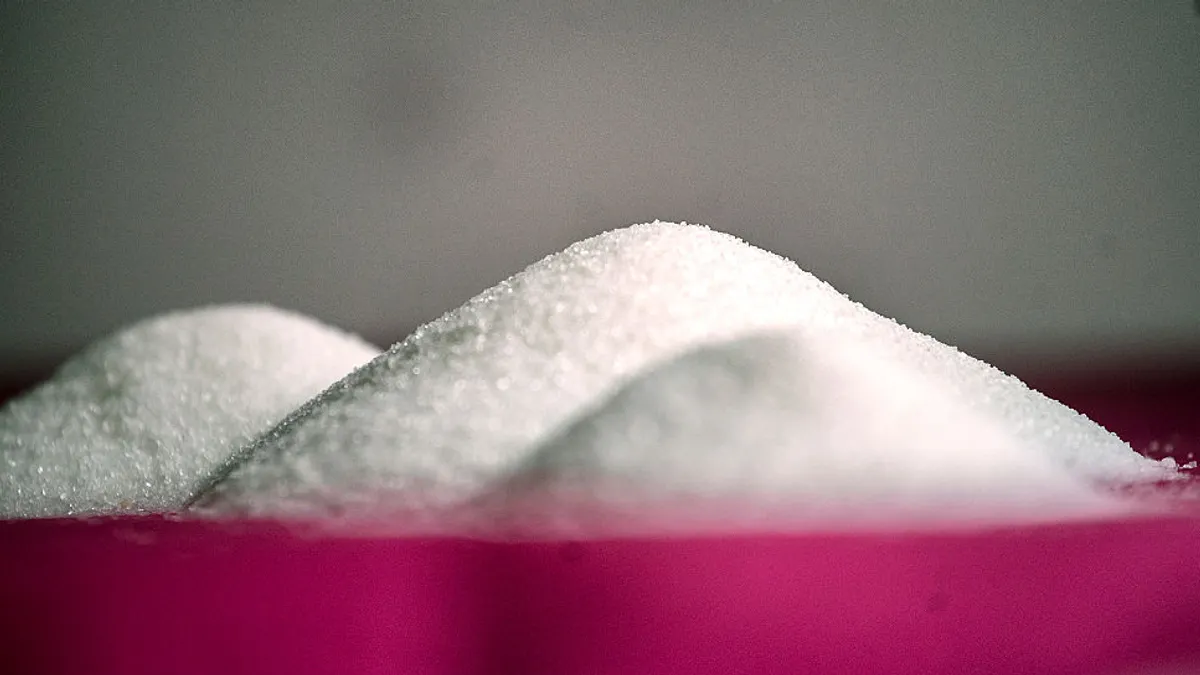
- General Mills, Mars, and Little Debbie owner McKee Foods have sued top sugar producers in the U.S., claiming suppliers illegally coordinated to raise prices to all- time highs.
- The food giants say in a lawsuit filed in Chicago this week they purchased several billion dollars’ worth of granulated sugar between 2017 and 2024, with prices experiencing steep increases even when adjusting for inflation.
- Prices then began significantly declining in 2024 after the sugar industry began to face antitrust lawsuits, food manufacturers claimed. The companies are seeking three times the financial damages inflicted by the alleged scheme.
Dive Insight:
Sugar is a key ingredient in packaged foods and snacks from General Mills' Cheerios to Mars' Snickers, Twix and Skittles. Food giants claimed in the suit that a consolidated sugar industry makes it "structurally susceptible to collusion."
The lawsuit claims that sugar producers, including United Sugar and Domino owner ASR Group, used a data-sharing clearinghouse to illegally exchange sensitive information on demand, capacity and other key production metrics. This allowed them to coordinate pricing strategies.
"The exchange of pricing, crop size and yield, and sold-position data was designed to — and did — produce Granulated Sugar prices higher than those that would have prevailed in a competitive market," the food companies wrote in their lawsuit.
General Mills, Mars and McKee did not immediately respond to a request for comment. ASR Group and United Sugar also did not respond.
The food giants noted that the producers included in the lawsuit control 65% of the market, with the overall industry posting $13.5 billion in estimated revenue for 2024. The litigation comes after nearly two dozen antitrust lawsuits were filed against the sugar industry claiming collusion.
Granulated sugar is highly uniform, making the industry susceptible to collusion as price is usually the only differentiated factor between suppliers. Sugar imports are also tightly regulated through quotas, which makes it harder for competition to enter the space, food manufacturers say.
While food companies point to a decline in sugar prices in 2024 as evidence of potential collusion, the industry has faced a pricing collapse during the past few years because of a global surplus. Following shortages in 2020, production recovered in the U.S. with near-record production between 2024 and 2025.
Other agriculturally-intensive industries controlled by a handful of players have also faced lawsuits claiming price-fixing. The Department of Justice has opened an investigation into top beef producers following claims that companies exchanged sensitive information through data provider Agri Stats to control prices.