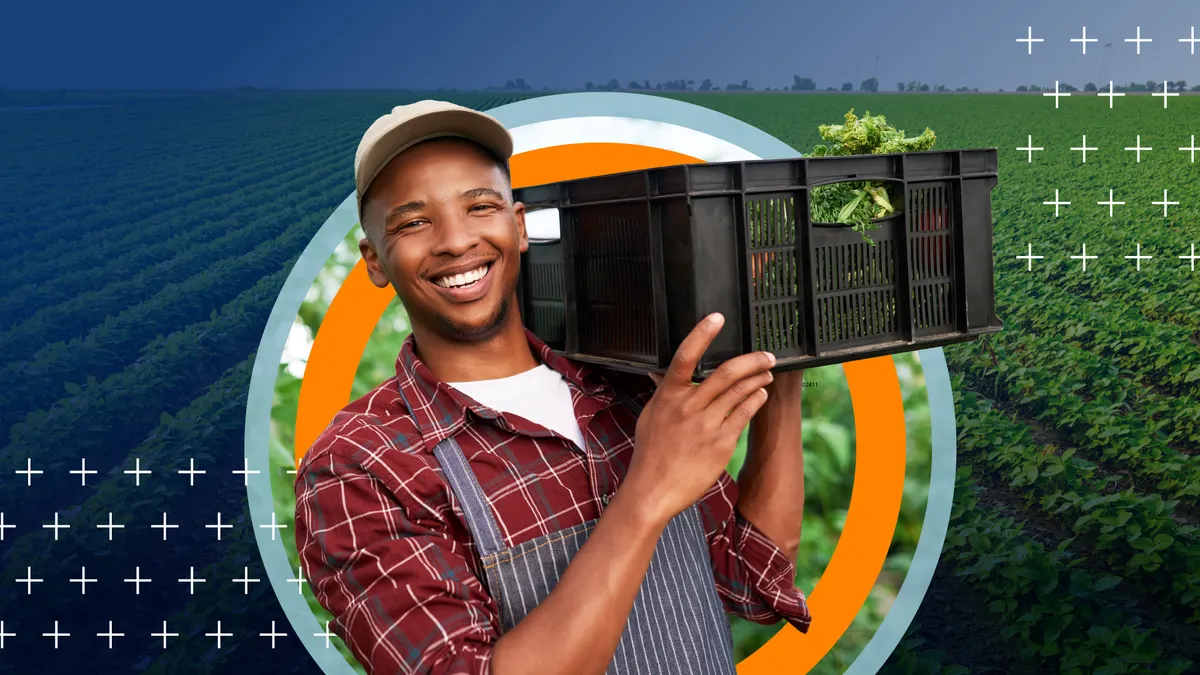

Picture tomatoes harvested in a field.
They’re picked. Cooled. Packed. Shipped. Soon, they pass through a processor or distributor, arrive at a restaurant or retailer, and ultimately land on a consumer’s plate.
The tomatoes move quickly.
The data needs to keep up.
At each step in the supply chain, trading partners depend on information captured before the product reaches them. Where did the tomatoes come from? Which batch/lot were they assigned? When were they harvested, packed, or shipped?
As the food industry continues preparing for FSMA Rule 204 requirements, recording and sharing critical traceability information is becoming increasingly important.
But every journey starts somewhere. Sometimes, it’s a farm with spotty cell service, limited technology, and workers whose expertise lies in producing and harvesting food, not in managing complex digital recordkeeping systems.
That creates a challenge with implications affecting every link in the supply chain.
The knee-jerk response may be to pursue the latest, most sophisticated technology. Yet the best solution may be the simplest.
That’s the thinking behind GS1 US Rapid Record™, an SMS-enabled tool that uses familiar, multilingual text prompts to help growers create digital traceability records without overwhelming users with complex new systems.
It’s an example of how making data collection easier at the very beginning of the supply chain can strengthen traceability for everyone who handles the product afterward.
Why traceability is only as strong as the data that starts it
A retailer may have a state-of-the-art traceability system. A distributor may have invested heavily in digital recordkeeping. A restaurant chain may have established rigorous food safety protocols.
But none of those capabilities make up for information that was never captured in the first mile.
Food traceability is a shared responsibility. At each Critical Tracking Event (CTE), from harvest to cooling, to initial packing through shipping, receiving, and transformation, trading partners contribute information that helps establish a product’s history and movement. Missing or inconsistent data at any point can compromise the entire record.
“If you think you have it all figured out, awesome,” said Lucy Angarita, supply chain visibility director at GS1 US. “But you need to work with your trading partners because, if the data you're receiving isn’t accurate, the information in your own systems won’t be accurate either.”
The consequences of fractured data collection and communication extend beyond regulatory compliance. When a food safety issue arises, accurate traceability helps organizations identify affected products faster, narrow the scope of recalls, and minimize unnecessary disruption and waste.
Reliable upstream data also supports everyday operations, from inventory visibility and supply planning to product freshness. When something goes wrong, consumers usually don’t blame the grower, producer, or distributor responsible. Often, they know only the last link in the chain.
“It’s your brand reputation, right? If I go to the store and get brown lettuce, I blame the store,” Angarita said. “I’m not going to think to blame the supplier.”
The first mile presents unique challenges
A large agricultural operation may have dedicated technology, digital recordkeeping, and personnel focused on managing traceability. A smaller operation may look a lot different, relying on handwritten notes, paper field tickets, or spreadsheets to document the same information.
Even when the technology is available, conditions aren’t always ideal. Wi-Fi coverage can be unreliable in remote fields. Workers may speak different languages or have different levels of experience with digital tools.
For downstream trading partners, those differences create a dilemma. They need reliable, standardized data from suppliers whose resources may vary drastically.
And the work doesn't stop while records are being created. Harvesting and packing operations must keep moving, leaving little room for cumbersome processes that slow production.
Requiring everyone to adopt the latest technology isn’t necessarily the answer. A new system that demands extensive training, additional data entry, or significant changes to established workflows may create more problems than it solves.
“Growers today have a lot on their minds, without having to be trained on a sophisticated system,” Angarita said.
Simpler processes, she said, can encourage broader adoption.
Making digital traceability friendly and familiar
What if capturing that information was as simple as sending a text message?
That’s the idea behind GS1 US Rapid Record™, designed to help growers create standardized digital records without reinventing the wheel or adding technological friction.
Growers have different levels of comfort with technology. While some may be ready to adopt more sophisticated digital tools, others who have spent years in the field prefer the familiarity and simplicity of text messaging. Rapid Record meets them where they are with SMS text prompts available in multiple languages.
A worker identifies the product and activity they’re recording. Harvesting tomatoes, for example. A series of simple questions follows, gathering information on quantities, dates, and locations. Each response contributes to the Key Data Elements (KDEs) needed to document Critical Tracking Events under FSMA 204.
“They don’t have to worry about identification or anything like that,” Angarita said. “They just respond to simple questions about the lettuce or the berries or whatever they’re harvesting in that moment. And then they can go on about their work.”
That interaction produces a standardized record that can be emailed as a spreadsheet or CSV file shared with downstream trading partners.
The next distinction is important.
Organizations throughout the supply chain don’t have to use the same technology to achieve effective traceability. They need to capture and exchange information in consistent formats that their respective systems can understand.
Rapid Record sets up the process for success by creating and sharing the information already in a format that trading partners can build on as the food travels along its journey.
The process is simplified from the start, stripping away complexity from first-mile data collection without sacrificing accuracy, consistency, or completeness.
‘Bring your partners with you’
Better first-mile traceability cannot begin and end with the grower.
Processors, distributors, retailers, and restaurant operators all have an important role in helping their suppliers capture and share the information that everyone needs.
That starts with clear expectations. Downstream partners should communicate what information they require and establish consistent standards for identifying products and locations.
They should recognize that not every supplier has the same capabilities. Some may need additional guidance or resources.
“You depend on each other, regardless of where you are in the supply chain,” Angarita said. “You need to make sure your trading partners are on the same page of the progression. So, bring your partners with you.”
Organizations managing extensive supplier networks should prioritize high-volume or business-critical suppliers. Testing how information moves between trading partners can reveal gaps that otherwise might remain hidden until a recall or other disruption.
“You can’t just say, ‘I’m going to take care of my four walls,’” Angarita said. “That’s not going to work anymore.”
From the moment a strawberry is picked in a field to the moment it's served on a plate, every trading partner has a stake in getting traceability right.
The stronger the information captured at the beginning, the more confidence everyone can have in what comes next.
To strengthen your first-mile traceability, learn more about GS1 US Rapid Record™ and GS1 US resources for FSMA 204 preparedness.