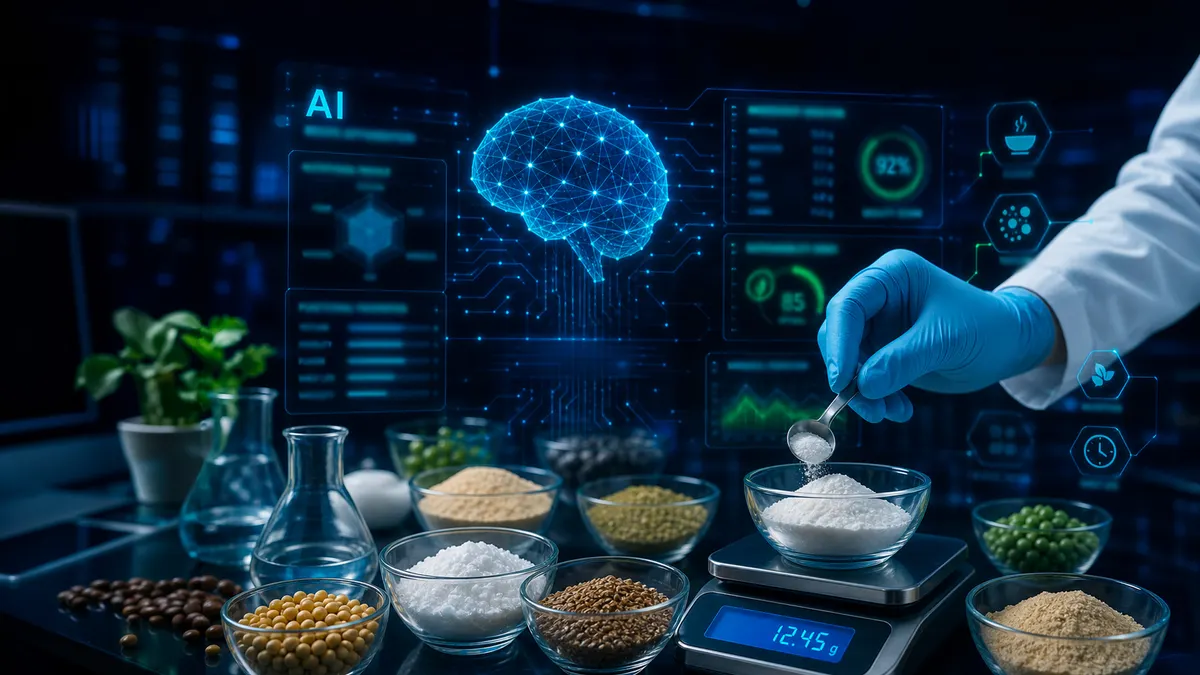

Every formulation is a balancing act. Food scientists constantly weigh cost against functionality, nutrition against taste, innovation against feasibility. Adjust one ingredient, and a cascade of decisions follows; supplier availability, label claims, regulatory requirements, processing performance, and consumer expectations all shift with it.
That's why AI is generating so much excitement in food R&D. McKinsey estimates AI could unlock up to half a trillion dollars in annual value by accelerating research and product development. But in formulation, speed alone isn't the breakthrough. The real opportunity is helping scientists balance more variables at once, uncover viable paths faster, and spend more time innovating instead of chasing information.
The real cost of late discovery
Few formulation projects fail because scientists lack creativity or technical knowledge. More often, projects stall because critical information surfaces too late.
An ingredient substitution affects functionality. A promising prototype jeopardizes a label claim. A lower-cost option creates sourcing risk. These discoveries often happen after multiple formulation cycles, leading to rework and delayed launches.
AI has the potential to shift those discoveries earlier.
"Embedding AI into the R&D process has the potential to compress the early stages of formulation, especially ideation, variant generation, substitution, and tradeoff analysis," says John Thorpe, Senior Director of Product Management at TraceGains. "In many organizations, those steps take significant time because food scientists are manually evaluating multiple constraints at once and pulling information from many different places."
Rather than replacing experimentation, AI helps scientists begin with stronger options before they step into the lab.
Helping scientists explore smarter
AI delivers the greatest value when it broadens a scientist's thinking, revealing formulation opportunities and tradeoffs that might otherwise take days to uncover.
Scientists remain in control, while AI rapidly compares ingredient alternatives, summarizes prior formulation work, and evaluates concepts against multiple technical and business constraints simultaneously.
"Food scientists need room to explore, but they also need to avoid creating concepts that are exciting in theory and problematic in practice," Thorpe explains. "AI-assisted formulation can help surface potential issues earlier by evaluating ideas against constraints such as ingredient functionality, claims, nutrition, sourcing feasibility, and quality or regulatory considerations."
High-potential concepts reach the lab sooner, reducing time lost to unproductive formulation paths.
Data that formulation actually needs
None of this works without trusted data.
Generic AI can suggest ingredient substitutions. But food manufacturers don't formulate with generic ingredients or generic supply chains. They formulate with approved suppliers, validated specifications, proprietary recipes, historical experiments, internal SOPs, and years of organizational knowledge.
When AI has access to that connected context, it becomes far more useful. Instead of recommending "any" emulsifier or protein source, it can evaluate options based on ingredients already approved within the business, supplier capabilities, historical formulation outcomes, and existing procurement relationships. Where information gaps exist, AI can even help identify qualified alternatives across a connected supplier network.
This is where AI moves beyond being an assistant to becoming a true co-agent for R&D.
Confidence, however, depends on data quality. Recent industry research from TraceGains found that accuracy and trust remain the number one barrier to broader AI adoption among food and beverage professionals. Governed supplier, ingredient, and formulation data provide the foundation for recommendations scientists can evaluate, and trust.
The future is collaborative intelligence
AI is emerging as a true co-agent for food scientists, expanding their ability to explore, evaluate, and refine formulations while leaving scientific judgment firmly in human hands.
"The future is not AI replacing food scientists," Thorpe says. "It is food scientists working with AI-native systems that can generate options, compare tradeoffs, capture evidence, and connect exploratory work to governed enterprise systems. That will make R&D faster, more transparent, and more collaborative."
As AI matures, the organizations that benefit most won't simply be those that adopt new technology. They'll be those that connect AI to the rich enterprise data that already exists across formulation, supplier management, and product development.
Solutions like TraceGains AI Formulation reflect this emerging model by bringing AI-assisted formulation together with governed supplier, ingredient, and specification data in a connected R&D environment. For food manufacturers looking to accelerate innovation, lasting advantage will come from making better formulation decisions backed by trusted enterprise data.