Editor’s note: This story highlights takeaways from an Oct. 28 Food Dive event that explores how CPG food brands can innovate for health and wellness. Register here to watch the replay on demand.
As more Americans take GLP-1 medications for weight loss, food and beverage companies are innovating to reach consumers who are eating less thanks to the appetite-suppressing drugs. But experts say there are risks in creating products or labels solely for shoppers on these medications, noting the wide range of needs among consumers on GLP-1 weight loss journeys.
"The GLP-1 user is not a monolith," Dan Weisbach, vice president of beverage accelerator LA Libations, said during a virtual event hosted by Food Dive last week on innovating for health and wellness. "What I see that works is building a great brand that benefits from GLP-1 adoption, not a brand that is wholly dependent on it."
Around 11% of U.S. adults currently take GLP-1 medications for weight loss, according to a Gallup update in September, compared to just 3% in 2024. With 137 million Americans — or more than half of all adults — eligible for the drug, the market for these medications is expected to skyrocket.
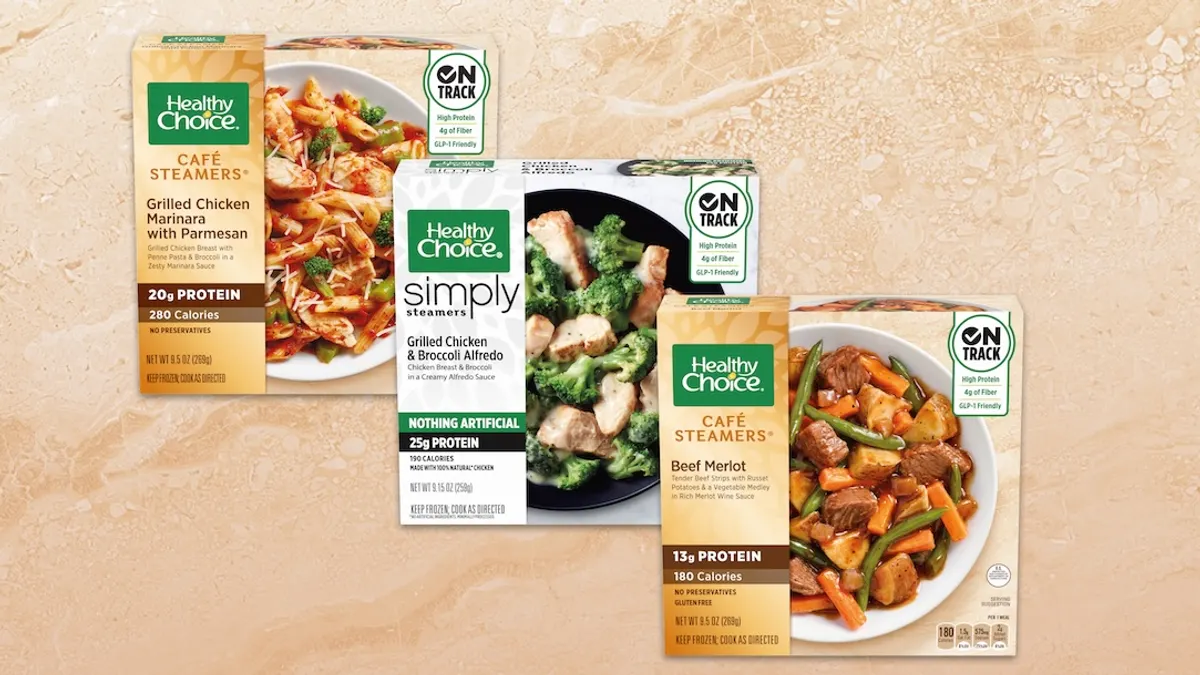
Food companies have responded with smaller portion sizes and options loaded with protein or fiber to support consumers' nutritional needs while they're on the medications. Conagra added a "GLP-1 friendly" label to call out these nutrient-dense products while Nestlé launched an entirely new brand targeted at GLP-1 users.
Kristie Sigler, global managing director for food, agribusiness and beverage at marketing agency FleishmanHillard, said "the jury is still out" on the effectiveness of GLP-1 labels. Consumers may have different nutritional demands depending on where they are in their weight loss journey – somebody just starting on the medication will have different needs than someone who has been on GLP-1s for months, for example.
Consumers also need support for when they stop — or restart – taking these medications. More than half of GLP-1 users also stop taking the medication within the first two years, with many restarting after regaining weight.
"How do you market to what we think of as a kaleidoscope of consumers?" Sigler said. "That really is the challenge that a lot of food companies are currently trying to figure out."
Dairy giant Danone created a yogurt drink designed for GLP-1 users called Oikos Fusion that includes fiber and a patented blend of proteins to help consumers support muscle mass and gut health. Instead of a "GLP-1 friendly" label, however, the drink markets itself as "muscle + digestive health support."
Miguel Freitas, vice president of nutrition and scientific affairs at Danone USA, said while consumer experiences with weight loss medications may vary, shoppers will need nutrient-dense options with protein and fiber no matter where a consumer is on their GLP-1 journey.
Formulating products for GLP-1 users goes beyond adding protein or fiber, with Freitas noting that calorie count and sugar content are just as important. But there also needs to be more education for GLP-1 users on how to make informed food choices while taking the medications, including from pharmacists and nutritionists, Freitas said.
Danone created a GLP-1 nutrition hub that partners with external dietitians to help consumers tailor their diets with science-backed guidance.
"You need to be more educated on what you pick at the shelf, with or without having 'GLP-1 friendly' on [the] front of pack," Freitas said.
GLP-1s have also accelerated demand for functional ingredients and minimally processed foods, and companies may be able to reach broader audiences by positioning products as healthy.
Instead of pigeonholing a product solely for GLP-1 users, it may make more sense for food companies to educate shoppers on the importance of ingredients such as protein or fiber, Sigler said.
"The industry conversation is going from those very general protein and fiber conversations to very specific elements of those to help people make smarter choices," Sigler said. "I think what we're seeing is smarter and more targeted messaging."