As food companies look for ways to speed up innovation and develop products that resonate with fickle consumers, a major source of inspiration for PepsiCo is coming from professional chefs.
The manufacturer of Doritos, SunChips and Lay's, with $94 billion in annual revenue, is placing greater importance on incorporating culinary trends and insights into product development.
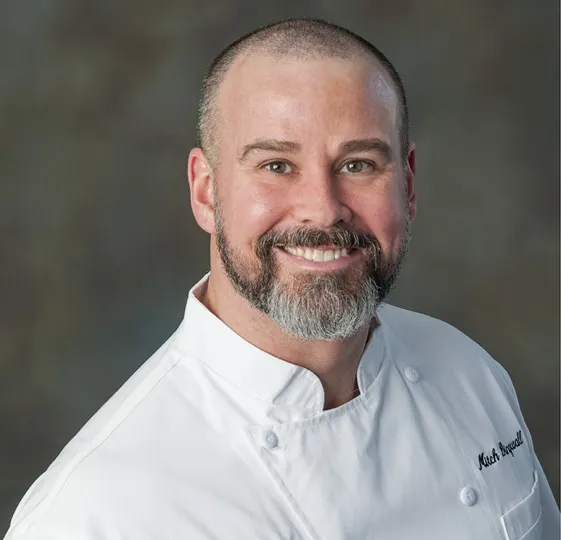
Mitchell Dingwall, PepsiCo’s director of global culinary capabilities, is a big part of that push. He oversees a team of trend spotters, growth strategists, food scientists, brand builders and culinary anthropologists from his office in Texas to help develop the food giant's next big innovation.
He and his colleagues help uncover novel flavors and trends that are infiltrating restaurant and home kitchens around the world to see whether they could be incorporated into PepsiCo products. The team evaluates new innovations based on taste, whether the necessary ingredients can be procured and if it’s a logical product for PepsiCo to make from a business standpoint.
Dingwall, a trained chef who enjoys food science, said his unique combination of skills results in a “competitive advantage” for PepsiCo.
Food Dive sat down with Dingwall to talk about the food and beverage giant’s innovation process, how it is evolving and the importance of leveraging culinary insights in product development.
This interview has been edited for brevity and clarity.
FOOD DIVE: How do you find ideas and trends that you bring back to PepsiCo?
Mitchell Dingwall: We zoom out and then we zoom way in. Those things, those little techniques, those little tricks, those little distinct nuances, how are they driving value, and how do we apply them to our business? We're in grocery stores. I spend a lot of time, most men go to Home Depot on the weekend. I go to Sprouts and H-E-B and all the grocery stores around here, and I'm just looking at shelves and looking at flavors and new ingredients.
Just the other day I saw these balsamic caviar pearls, which I was like, "That's super interesting.” And we're talking about snacks at work, and I'm like, "How could they make their way into a snack?” That's part of the creative process. It could be something I see in a grocery store that sparks an idea for a full product design.
Give an example of something you observed in a restaurant or grocery store and how it made its way into a PepsiCo product?
The chip flavors for Lay’s during the World Cup, those were great examples. We had a constraint to focus on different countries' cuisines. So for Brazil, we went and we searched: What are the iconic flavors? We went to a Brazilian market here in Texas. We did immersions, and we worked with our marketing cross-functional partners in marketing and insights because everyone sees things differently. We got a deep understanding of that cuisine, the culture, the flavors, all that. We go to restaurants. We go to markets. In this particular example, we have a chef in Brazil to keep us honest. What are the true, authentic things? We landed on a white garlic kind of garlic sauce popular in Brazil.
So how do we take that thing, keep its integrity, and also bring it into something that we can manufacture on a chip and not lose that translation? That's really the heart of the culinary process. We shepherd that whole thing. We decide, here's the gold standard target. We get many different iterations of that. And then, we have to consider the American palate; we've got to caramelize or toast that garlic because that's a more approachable, familiar execution for the U.S., for example.
Walk us through the complexities and challenges of working with ingredients?
I tell people what I do, and they're always like, “How much can you do with chips?" But there's so much science. Like when you really zoom in, we can geek out on a topic like black pepper.
Or there are so many things around vanilla. Vanilla's got, I don't know, 3,500 flavor compounds in it. It's funny to me, people describe vanilla as boring, or bland, or plain. But actually, vanilla is so complex. And if you use vanilla in the right way, in the barbecue sauce or something like that, there are so many flavor compounds and volatiles that are just happening that give you this distinct thing.
That's where the psychology and the physiology come in, too. We've got PepsiCo and the luxury of all these resources where I can work with scientists to really understand what's happening in consumers' mouths when they're tasting garlic.
How would you describe your job at PepsiCo?
My role is very unique, and not many food companies have this. It's actually a competitive advantage and point of distinction. A lot of companies have chefs in culinary, but the way PepsiCo uses it is very strategic in nature and more forward-looking. I'm a culinary person who has some scale, like a food science background, but also business and innovation in mind that I can help see these culinary signals and make sense of them for PepsiCo.
I will do projects, but I do them under the guise of a better way of working. I'll take that assignment and I'll put it through my process in parallel with, or different from, the project team, so I'm testing the process on how efficient it is, how fast it is, and then trying to put some key performance indicators in place to see if my method, my structured ideation, works.
Other teams at other companies might be sitting there thinking like the old way of doing it, like, “Hey, what are some cool ideas, and we vote for our favorite one.” That's the old way of doing things. But if you do that same method, you're always going to get the same results.
I'm kind of tasked with capturing the secret magic and codifying it, making it repeatable, like turning that creative process into a more methodical innovation model, which is problem-solving.
It is very unique and distinct, and folks are not usually accustomed to it. The chefs are usually making lunch or cooking things in the back. They're not really embedded in R&D and innovation process and driving business value. So that's a shift on how the company views culinary and is leveraging it. It's a much more powerful engine now that we're using in the development process. There's a lot of detail and nuance.
As a culinary person who's interested in science and really understanding and deconstructing what's happening on a molecular level, because when people start to hear science and food, they get a little nervous too. I'm also that counter-anchor balance for the organization as we talk about functional ingredients and protein and all those things, where the consumer is going, the same conversation.
For example, you can add protein to something but does it taste good? Is the protein in the right context? Are the flavors making sense? Are the flavors helping the palatability of that protein? Are we designing it like a chef would? Are we designing it like a procurement, marketing, engineer, food scientist would? So that's the shift, which is the really exciting thing for PepsiCo is that competitive advantage now that we're going to maximize and leverage versus our competitors.
How have you seen product development change during your time working in the food space?
I've had such a unique seat because I kind of came in from the restaurant scene when food also was transforming, in the early 2000s. Let's not forget 25 years ago, people didn't really know about culinary cuisine beyond Mexican and Italian.
You've had these challenger brands come up that really forced the competition, these big food companies, to respond because they were all about founders, purpose-led mission, farmers, mothers that had to feed their kids differently. It was purpose-based.
The food development process is so important because a couple of years ago, you and I would decide, all right, we're going to do a honey mustard lemon pepper Dorito. We could decide that right now. It'll be two years or a year and a half before that's on the shelf. But guess what, it will probably be irrelevant at that point.
Now, food companies are working more rapidly, more iteratively, more test-and-fail; versus before when a big CPG would launch something, and if it failed, a lot of egg on your face. But now we're thinking smaller, agile, like these more entrepreneurial companies that spurred this moment, this movement of like, you've got to be more food-focused, you've got to be more mission-based, more purpose-based, which is all about farmers and chefs and farm-to-table.
You saw that whole movement, and the food companies were like, “We're going to miss the boat, and we're going to lose credibility with consumers if we don’t think differently.”