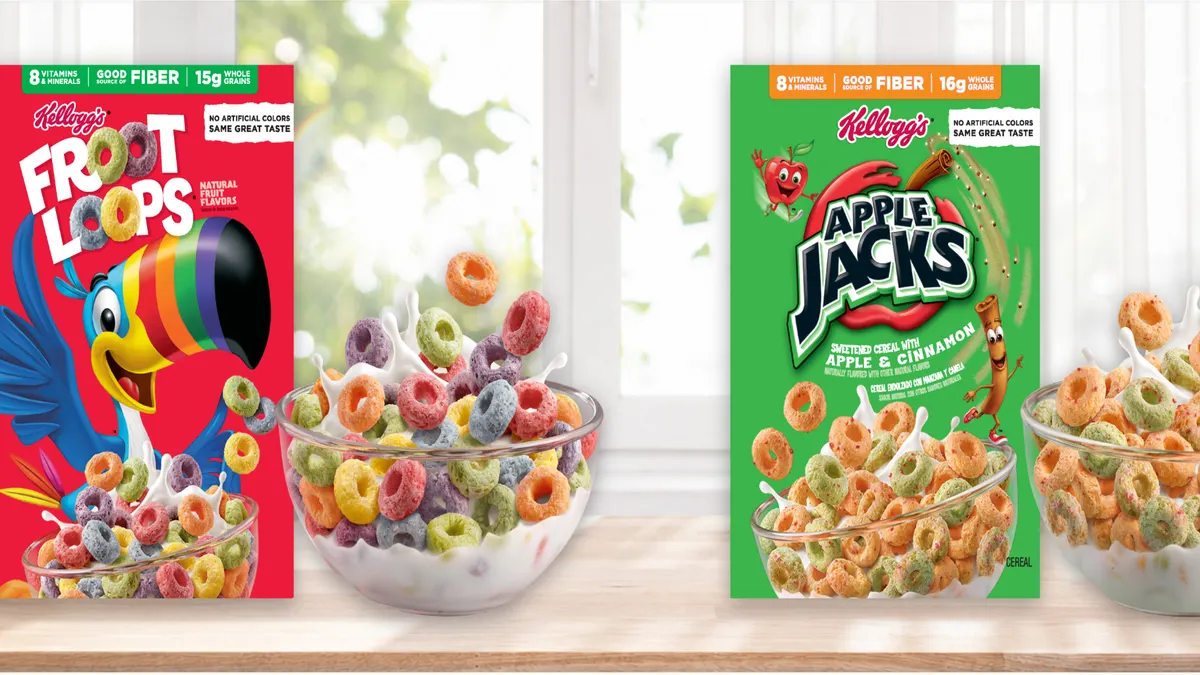
WK Kellogg will fully remove artificial colors from Froot Loops and other cereals later this year, nearly 12 months ahead of schedule — a move the company hopes will provide much-needed momentum to a category that has struggled during the last decade.
The food manufacturer had previously removed synthetic colors from most of its cereals, but some remain in Froot Loops, Apple Jacks and a handful of limited-time offerings, which collectively totaled about 15% of Kellogg’s portfolio. The Michigan-based company committed last year to entirely eliminate the use of the controversial ingredients by the end of 2027.
Kellogg will switch to six colors derived from fruit and vegetable juices, as well as other plant-based ingredients. For example, turmeric is being used for yellow and annatto for orange. Hundreds of different ingredient alternatives were tested.
Cereals using the new recipes will start being manufactured in the next few months, with shipments to retailers expected to begin by the end of the year.
Doug VanDeVelde, Kellogg’s chief growth officer, said changing to natural colors was a complicated and challenging process that required extensive work across development, manufacturing and resourcing.
Kellogg had to make sure there was enough supply of each natural color, while ensuring that the new products would have the same look, taste, texture and aroma that consumers are used to in their cereals.
“We did testing among thousands of consumers, moms and dads and kids and teens and people across generations to make sure that we were delivering the consumer experience that they expected and they wanted,” VanDeVelde said.
Kellogg rival General Mills, the largest cereal maker in the U.S., said last summer it would also remove artificial colors from its U.S. retail portfolio by the end of 2027. The Cheerios maker had tried to remove artificial colors before for Trix in 2016, though it brought the synthetic colors back after about a year following consumer complaints about the duller appearance.
Natural colors have a few challenges not found with their artificial counterparts. Unlike synthetic ingredients, natural colors are more difficult to deal with because they often need to be refrigerated. This required a “significant investment” in Kellogg’s manufacturing facilities to support the transition, VanDeVelde said.
Cereal sales have declined in recent years as many consumers shift toward more convenient options or foods they view as fresher and healthier. Kellogg has been aggressively promoting the benefits of its cereal during the last year, including revamping the back of boxes to tout nutrients like protein and fiber.
VanDeVelde said the transition away from artificial colors will generate a “positive halo on cereal" and "help people feel good about what they already want to love, which is a nice bowl of cereal."
Kellogg has become a lightning rod for critics who are pressuring food companies to rid their products of synthetic dyes.
Protesters descended on Kellogg’s headquarters in 2024 to push the company to honor a pledge it made nearly a decade ago to remove artificial colors.
A month after recommitting to removing synthetic colors in July 2025, Kellogg signed a legal agreement with the Texas attorney general’s office to remove artificial dyes from Froot Loops and its other cereals by the end of 2027. It was the first time a food company had gone beyond a verbal commitment and signed a legally binding agreement to remove petroleum-based colors, according to the state.
Even Health and Human Services Secretary Robert Kennedy Jr. has routinely called out Froot Loops as an example of a product containing synthetic dyes and other chemicals not used in other countries.
Stacy Flathau, a Kellogg spokesperson, said the FDA is “well aware of our journey” to remove artificial colors. She said the company has been in frequent contact with the administration throughout the process and that the agency has “been a good partner on this front.”
“We're really excited to talk to them about it because we're able to accelerate this announcement by a full year,” Flathau said. “We think they're going to be really excited about that and will help us celebrate the news.”
Shortly after taking the helm in 2025, Kennedy asked the food industry to voluntarily remove synthetic dyes before the end of next year. Nearly every major food company pledged to follow through, including Kraft Heinz, General Mills and The Campbell’s Company.
However, an industry-wide shift could prove difficult for companies in sectors like beverages and confectionery, which are more reliant on artificial colors. Supply issues and higher prices will make it challenging for the industry to quickly transition away from certified colors, a report from the National Confectionery Association found.