Dive Brief:
- Amy's Kitchen is closing a California production plant and eliminating about 260 jobs across its network as the pioneering organic frozen food brand streamlines its business to focus on its highest-growing categories.
- The company will shutter its Santa Rosa facility by next summer, a spokesperson said in an emailed statement to Food Dive. Amy’s will shift production to plants in Medford, Oregon, and Pocatello, Idaho.
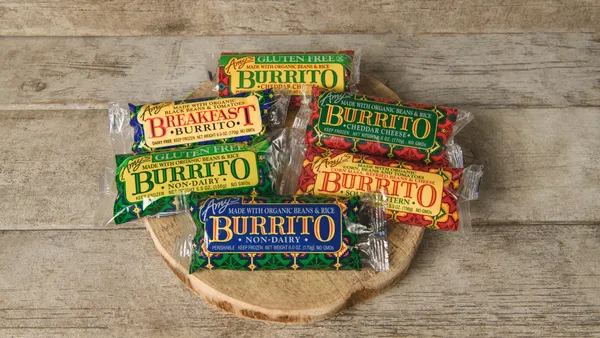
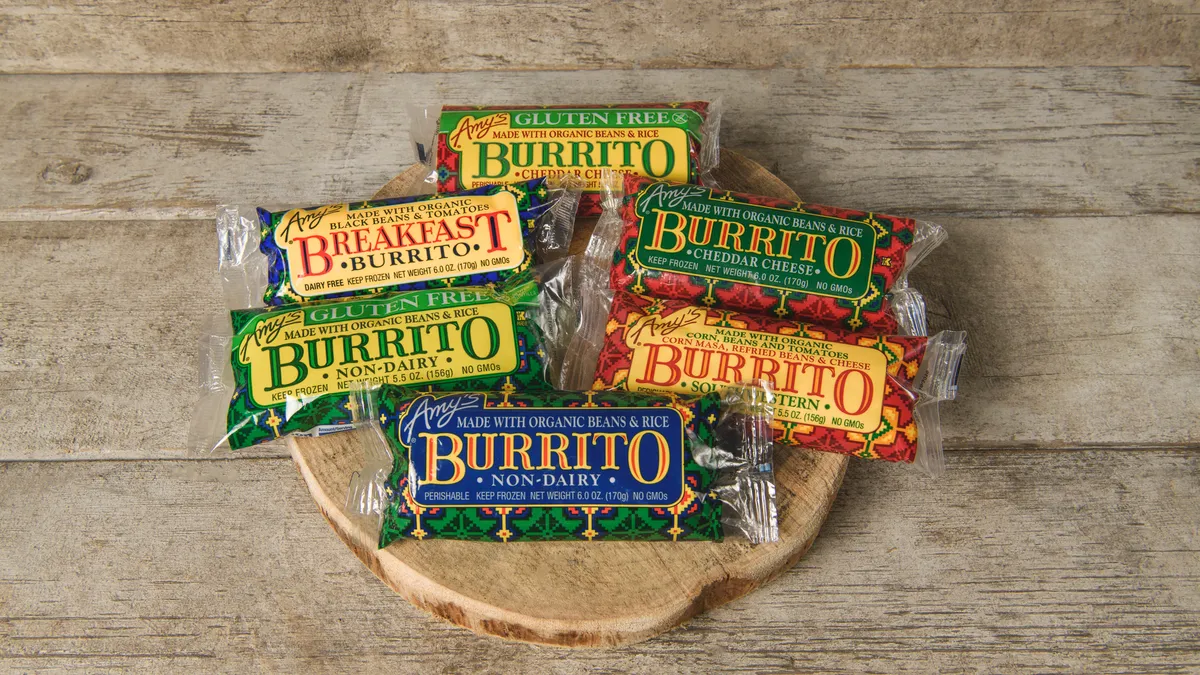
- The move will ensure each facility within Amy's manufacturing network focuses on "the product categories where it is strongest." Pocatello will become Amy's entrée facility, while Medford will produce pizza, soup and burritos.
Dive Insight:
Amy's CEO Paul Schiefer said in a statement that the company's "manufacturing network has become more complex than our business needs."
“This is hard, and it should be hard. We looked at every alternative before landing here, Schiefer said. "Aligning our network around what each facility is best positioned to do is what keeps Amy's operating efficiently for the long run.”
Amy's Santa Rose facility will close in two phases, with the first occurring at the end of this year. Around 207 roles will be eliminated in Santa Rosa as part of the closure, while another 51 layoffs will take place at Amy's canning area in Pocatello. The company plans to move those operations to Medford.
The frozen food category is undergoing a complex shift shaped by competing forces. While more consumers are interested in frozen foods as an option amid growing demand for convenience, affordability concerns have recently limited the sector's growth.
The frozen foods category is seeing a slight decline, Nestlé CFO Anna Manz said earlier this month at a Barclays conference, though there are pockets of growth for world cuisines, high fiber and protein as well as different pack sizes.
Amy's Kitchen has more than a 35-year history and is one of the pioneers of the clean-label movement. The brand is known for its gluten-free burritos and other vegetarian and vegan-friendly canned and frozen products.
Amy's has close to $1 billion in annual retail sales and has a supply chain capable of producing about a million meals a day, Schiefer told Food Dive earlier this year. The company has doubled down on its clean-label positioning, with more than 100 products certified under the Non-GMO Project's non-ultraprocessed label.
Schiefer said that while Amy's is seeing a lot of "interest" from consumers looking for better-for-you options, the brand has also faced challenges amid category-wide struggles.
"I've often felt like we're getting a lot of benefit from one [side] and we're facing some headwinds from the other," Schiefer said.