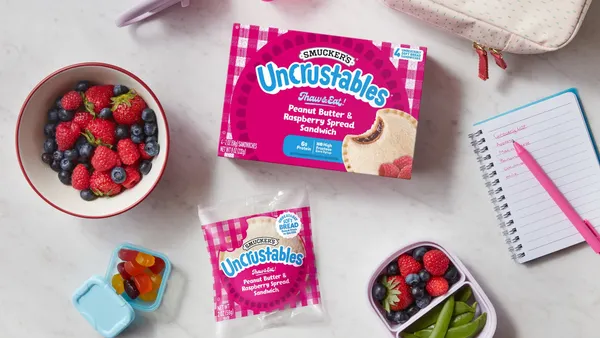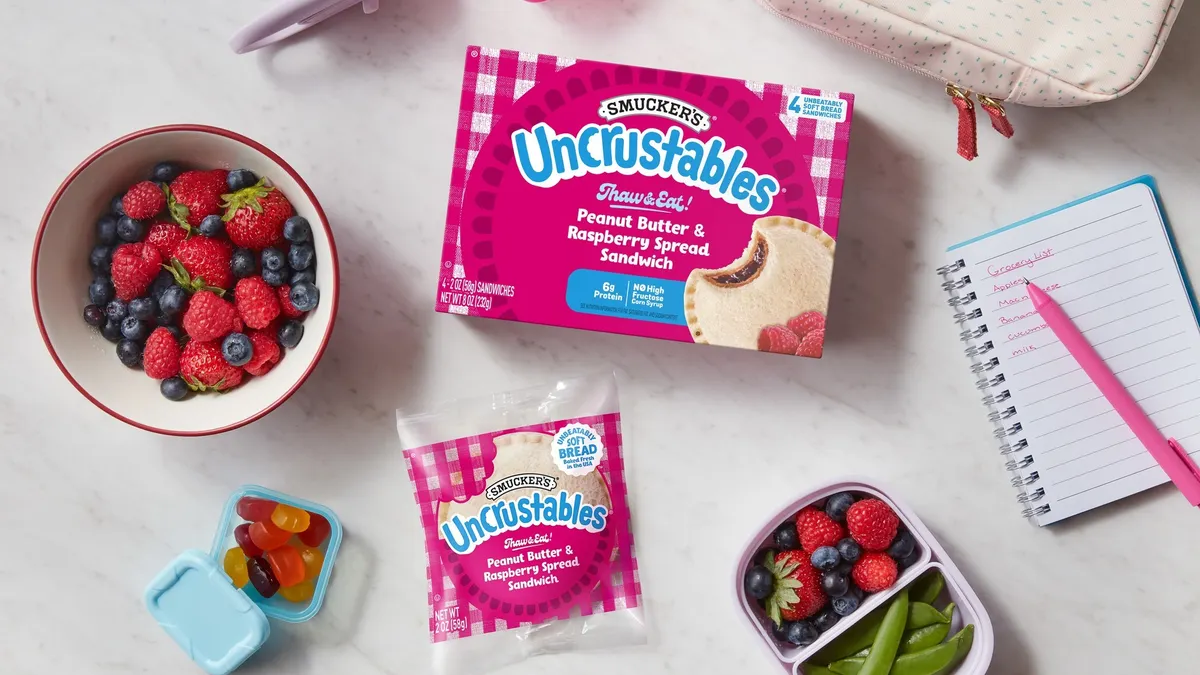
Uncrustables owner J.M. Smucker is turning up the heat on the already fast-growing, $1 billion frozen sandwich brand with one of the biggest innovations in its history.
Earlier this year, Smucker released an updated version of Uncrustables that consumers can store in the fridge for up to five days. For Smucker, the company is optimistic that the innovation will increase interest in Uncrustables among existing shoppers while attracting new customers to the brand.
Uncrustables, which debuted at retail in 2000, has traditionally been stored in the freezer. While this prolonged the life of the product, it meant that hurried consumers running out the door or in need of a quick fix of peanut butter and jelly had to wait — it typically takes Uncrustables about 30 minutes to thaw.
Time-starved and impatient shoppers came up with their own way to speed up the process, according to Rebecca Scheidler, Smucker senior vice president and general manager of frozen handheld and spreads.
Some consumers have turned to unconventional methods to warm the circular sandwiches, such as tossing them on their car dashboard or even sitting on them. Many shoppers have contacted Smucker directly, urging the Ohio company to come up with a solution.
“They were missing out on what they really wanted, which is wanting to grab it and eat it when they wanted it,” Scheidler said in an interview. “We said, okay, if that's the desire, what is it going to take for us to be able to deliver that immediate consumption need that they wanted, but without sacrificing the quality and the experience?”
For a refrigerated version of Uncrustables to last, and to provide the same eating experience as the frozen offering, Smucker had to make “some modifications” to its existing recipe, Scheidler said.
Smucker spent much of the development time figuring out how to maintain the soft, pillowy bread while making sure the sandwich didn’t go stale or turn soggy sitting in the fridge. The food and beverage company also had to ensure that the peanut butter and jelly mix inside the Uncrustables didn't seep out so consumers still got the “burst of flavor” when they bit into it.
The new Uncrustables fridge-friendly feature will open up a “very sizeable opportunity” for the brand by attracting new consumers and encouraging existing buyers to purchase more often, Scheidler said.
Smucker has previously broadened the reach of Uncrustables by launching limited-time flavors and a version with 12 grams of protein. But the move to the fridge will unlock further opportunities for growth.
Around half of consumers have never tried Uncrustables, and Smucker found 50% of those non-buyers said they would be more likely to purchase the sandwich if they didn't have to wait for it to thaw. Meanwhile, 72% of existing users said they would eat the product more often if there was a refrigerated option.
”As much beloved as the brand is, we still have half of people who still haven't even tried the brand,” Scheidler said.
Uncrustables were created in 1995 after David Geske, who ran a packaged ice business, was entertaining his friend Len Kretchman and his family for dinner, according to Smucker. For lunch, their kids asked for PB&J’s — with the crust trimmed off. David and Len’s spouses, Kristen Geske and Emily Kretchman, suggested that their husbands should mass-produce the product.
The Crustless Wonder was launched a year later, and Smucker purchased the brand in 1999 — renaming the product Uncrustables. Its success has prompted several competitors to enter the market.
Smucker, aiming to protect the brand, has taken notice. Last year, the Ohio company sued retailer Trader Joe’s, alleging in its lawsuit that the grocery chain’s version of crustless PB&J sandwiches are an “obvious copycat” of its Uncrustables frozen sandwiches.
“Competition is welcomed because it helps grow the category,” Scheidler noted. “But we still have this obsession with continuing to bring what's next, and I think that's really what's going to help us to stand apart from just the industry in general because we're going to continue to push ourselves to disrupt.”