
The food industry is preparing for a seismic shift in the way that all companies, both food- and nonfood-related, will leverage data and technology for digital record keeping (Digital Product Passports, or DPP), traceability, regulatory compliance, marketing and more.
While the UPC codes that have appeared on products for the past 50-plus years have been a boon to retail checkout efficiency, the next iteration of scannable codes, known as 2D barcodes, promises to provide a multitude of additional benefits, including enhanced food safety and transparency, improved inventory management, and the ability to provide content and messaging for consumers.
Forward-thinking companies such as Kwik Lok have been a catalyst in testing the opportunities these barcodes provide with partners such as Earth Fresh Farms and GS1.
What is Sunrise 2027?
Sunrise 2027, scheduled to take effect at the end of that year under the auspices of GS1, the global data standards organization, is the deadline by which all checkout terminals and other scanners used in product logistics must be able to read 2D barcodes. These codes—QR codes are one example—have the ability to contain much more information than 1D barcodes. They can carry thousands of alphanumeric characters versus just 20-25 characters in a UPC barcode. This can include not only product identification numbers and lot numbers, but also ingredient and sourcing information, marketing materials, and just about any other content that companies might wish to make available to their customers and industry partners.
The dawn of the 2D barcode era comes as the industry is also preparing for the Food Traceability Final Rule of the Food Safety Modernization Act to take effect, which will require heightened levels of product record-keeping — part of an effort to improve food safety and speed product recalls. The Food and Drug Administration’s proposed deadline for the rule is July 20, 2028.
The need to record the precise path of products throughout the supply chain in order to comply with the FSMA rule will likely accelerate the adoption of 2D barcodes, says Chris Latta, director of business development at Kwik Lok. In the meantime, companies such as Kwik Lok are also working with industry partners to leverage 2D technology in ways that could drive sales in addition to ensuring FSMA compliance.
Kwik Lok supplies packaging closures and labels that can be attached to these closures, as well as the technology to print and apply them. The company has been deeply involved with the Supply Chain of the Future initiative, which is focused on harmonizing the data used by the industry so that all participants are “speaking the same language” around product identification.
The need to act early
Brands that begin testing 2D barcodes well ahead of time—several companies are already doing so, and more are joining them in the coming months—stand to be better prepared when the deadlines for Sunrise 2027 and the FSMA rule take effect. Companies will benefit from early planning not only for FSMA compliance, but also for optimizing the marketing opportunities that 2D barcodes offer, says Latta. Information that 2D barcodes can provide, such as real-time sales data and instant feedback from A/B testing, will fuel future marketing efforts among the companies that master this technology.
“This is becoming table stakes across the competitive landscape,” says Latta. “Those who move early have a clear advantage.”
Likewise, companies that begin testing 2D technology now will have a leg up when it comes to working more closely with their business partners and driving shared positive outcomes, says Drew Zabrocki, strategic lead at the Supply Chain of the Future initiative.
“People who get on board early are going to be leaps ahead of those that are lagging because the potential applications are so great, and we’ve just scratched the surface in terms of the things we can do,” he says.
The 2D codes will facilitate the creation of deeper relationships among both industry and partners and among retailers, suppliers and consumers, says Zabrocki.
“It’s a fundamental transformation enabling information to connect every stakeholder in the value chain,” he says.
It is especially important for the produce industry to begin testing 2D barcodes early, says Latta, due to the challenging environments their products undergo, from muddy fields and temperature fluctuations during transit to wet retail produce displays.
EarthFresh tests 2D marketing program
One of the pioneers in the testing of 2D barcodes, in collaboration with Kwik Lok, is EarthFresh Farms, a produce company with operations in both the U.S. and Canada.
EarthFresh recently launched a campaign that is providing detailed information about some of its newest potato varieties, called Butter Potatoes, known for their rich, buttery texture. The line includes Butter Golds, Butter Reds, and Butter Russets, each of which have their own unique characteristics. The campaign is also being extended to the company’s Potatoes of the World varieties.
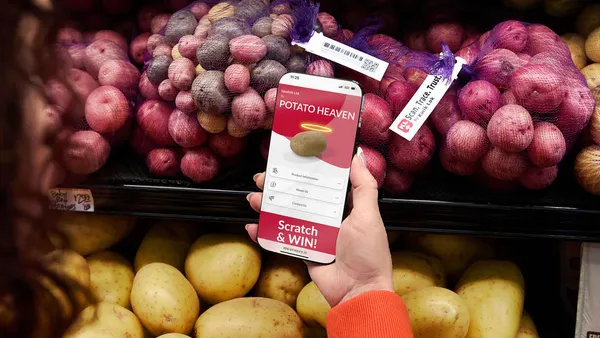
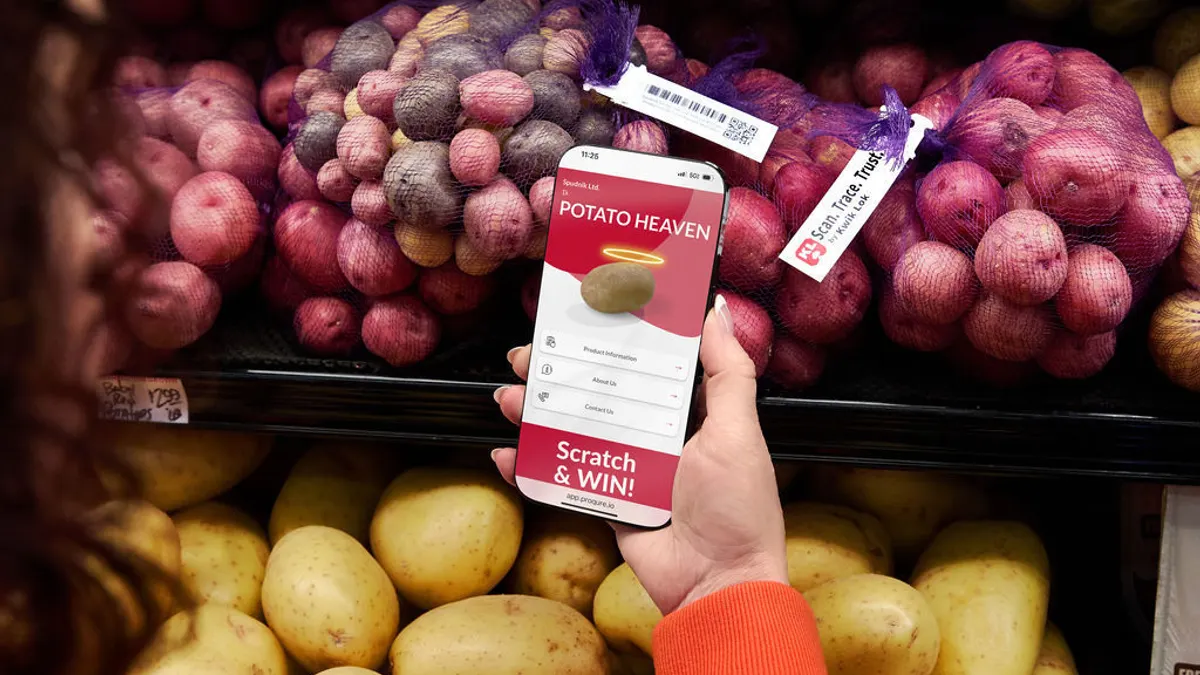
Using the company’s existing Kwik Lok bag-closure technology for automation and printing, EarthFresh is attaching labels to the bag closures that it has printed with QR codes. Consumers can scan the codes with their smartphones to unlock a trove of information about the potatoes. EarthFresh is stocking this digital content portal with videos and recipes from luxury catering chef Yann Nury, sensory notes for each of the potato varieties, cooking tips and other information geared to drive consumer engagement with the brand and encourage repeat purchases.
“This platform really transforms potatoes from a commodity to a premium kitchen companion,” says Lisa Pugliese, creative marketing manager at EarthFresh. “We don’t want the potato shopping experience to stop at checkout.”
In addition to the QR codes that are printed on the Kwik Lok labels, the codes are also displayed on in-store signage at retail locations. EarthFresh is also looking into driving consumer digital engagement with a prize giveaway, says Aislyn Gonzalez, digital marketing associate at EarthFresh.
“That is another way we’re trying to get consumers to go out there, find the product and interact with the QR code,” she says.
Both the Butter Potatoes and the Potatoes of the World varieties lend themselves to these information-rich campaigns in part because they may be new to many consumers, and the digital content will help familiarize them with the items.
“We’re really hoping that we’re going to get consumers excited about the potatoes,” says Pugliese. “We’re going to encourage repeat purchases but also inspire shoppers with new ways to use these varieties and different ways to cook them.”
EarthFresh is currently limiting its test of 2D barcodes to the marketing applications, but the company also plans to eventually deploy the technology for enhanced product traceability, says Pugliese.
Visit KwikLok.com today to learn more about how Kwik Lok can help your company capitalize on all of the opportunities that 2D barcodes provide.