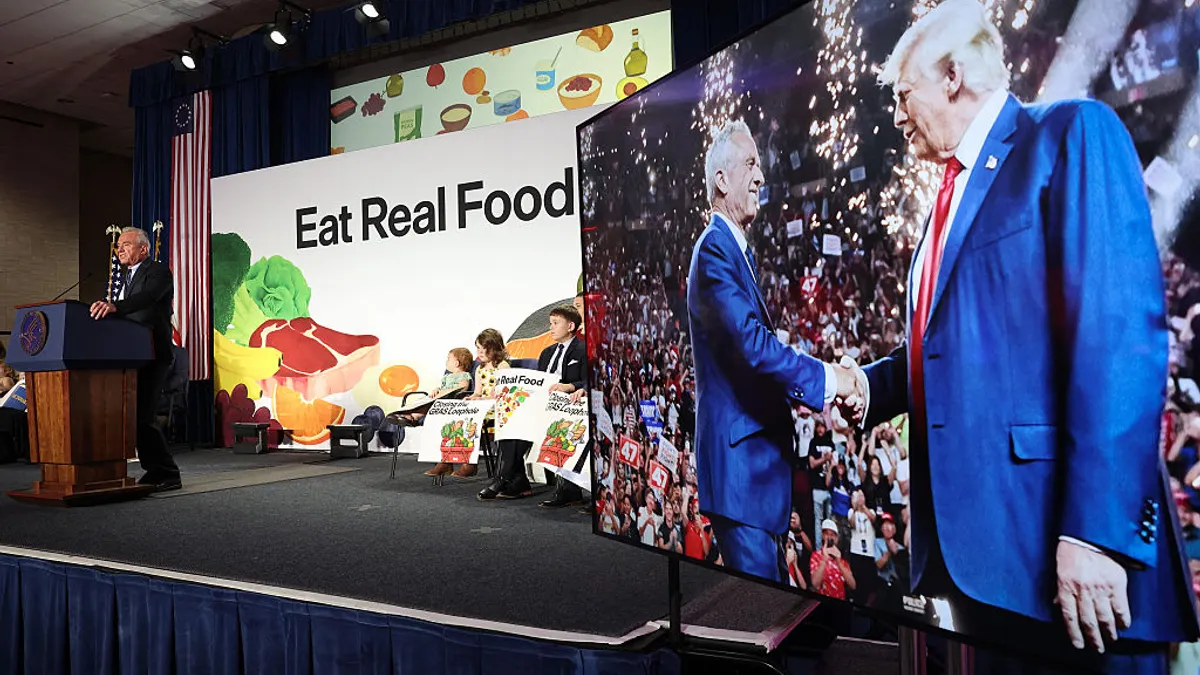
The following is a guest post from Sean McBride, founder of DSM Strategic Communications and a former executive vice president of the Grocery Manufacturers Association (now the Consumer Brands Association). Opinions are the author’s own.
It’s hard to avoid news coverage of the post-election infighting taking place among Make America Healthy Again leaders, the White House and influential members of Congress. Finger pointing, personal attacks and blame are being levied by folks on both ends of Pennsylvania Avenue about MAHA’s past, present and future.
Speculation is running rampant about whether Health & Human Services Secretary Robert F. Kennedy, Jr. will remain in office for the remainder of the Trump Administration. And anonymous sources are predicting the FDA’s ultra-processed foods definition will be finalized with a pro-MAHA chief of staff in place at the White House.
Does any of it really matter?
Nearly two years after MAHA assumed the reins of power, there are still 125 million obese children and adults in the United States, 38 million people with Type 2 Diabetes and 119 million with hypertension.
The public health crisis remains virtually unaltered under this Administration.
Some folks associated with MAHA have accused staffers in the Trump White House of blocking the movement’s food policies based on mid-term election objectives.
However, another reason is most likely behind the Administration’s “pocket veto” of an ultra-processed foods definition and a front of pack nutrition labeling scheme.
What if the White House staff, Office of Management & Budget and the Domestic Policy Council did their due diligence, appropriately assessed RFK’s flagship policies and concluded one or both come with great cost and present little or no chance to improve public health? Or that they would not survive a federal court challenge?
Facts need to mean something in federal policymaking, but facts have been subjugated to passion and subjectivity in the public health debate for far too long.
Time and again, policymakers on both sides of the aisle have proposed or implemented costly, draconian policies on food production in the name of public health. Despite a lack of evidence bans, taxes, and labeling mandates actually work in reducing obesity and associated health problems, consumer activists and politicians keep going back to that well.
However, the “food is poison” movement is a political battleground of its own now. In the lame duck Congress and beyond, the left, the right and everyone in between in Washington, D.C., are fighting to see who will control the food policy agenda in 2027 and beyond. But control without purpose is meaningless.
Like far too many issues, the food policy debate has devolved into a naked political battle, overflowing with hyperbolic rhetoric for electoral gain. Blame is being cast – the healthcare system is to blame; food companies are to blame – but viable solutions are sparse.
As for the MAHA agenda, rational folks know food dye bans, GRAS reform, SNAP restrictions, and labeling mandates won’t do a thing to reduce obesity, diabetes and hypertension. Saying otherwise is disingenuous.
To even begin to make progress, there must be general acceptance that government mandates on farmers and food companies is not a viable pathway to improved metabolic health.
There must also be an acknowledgment that food companies and the marketplace are powerful allies – not antagonists – on the road to better individual and collective public health.
Collaboration between the public and private sectors – rather than confrontation – best serves consumers and the goal of reducing non-communicable diseases across America.
It’s the only way we will solve the public health puzzle that has avoided us for so long.