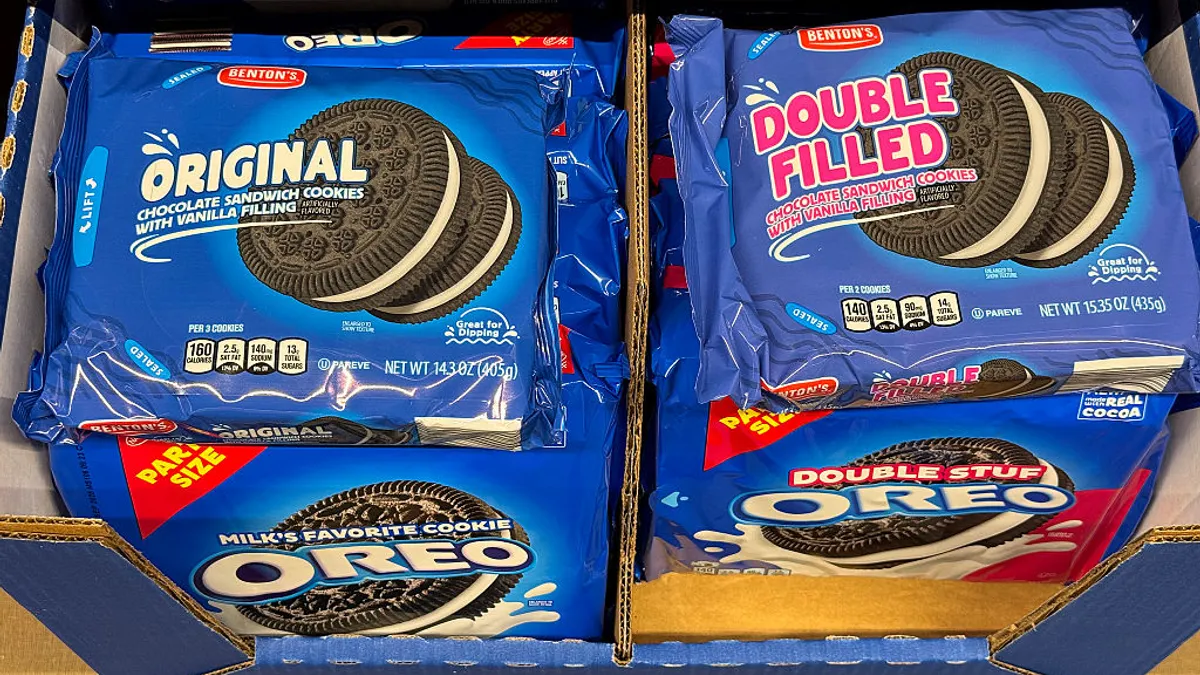
Oreo cookie maker Mondelēz International created a new generative artificial intelligence tool to help it personalize its advertising for consumers while boosting engagement for many of its top brands.
The snacking giant behind Chips Ahoy!, Ritz and Perfect Bar started working on the generative AI tool known as AIDA (AI + Data) more than two years ago, and so far has spent upwards of $40 million on the technology. AIDA enables Mondelēz to create marketing content faster and at a lower cost, often giving it the opportunity to personalize the material for specific consumer groups.
But while the upfront cost is high now, Mondelēz expects the tool could cut the cost of creating marketing content by up to 50%. It could save the company even more in the long term if it is implemented into other parts of the food manufacturer’s business.
Mondelēz, which launched the nascent platform in July, is still learning where and how to best use the technology across its sprawling worldwide snacking portfolio. The tool is still being tailored to understand the intricacies that come with each brand and how to remain responsible in advertising by avoiding the promotion of unhealthy behaviors such as overindulgence.
Jennifer Mennes, vice president of global head of digital marketing and strategy with Mondelēz, and Tina Vaswani, the company’s vice president of digital enablement and consumer data, recently sat down with Food Dive to discuss AIDA and the role of artificial intelligence in food marketing.
This interview has been edited for brevity and clarity.
FOOD DIVE: How long has Mondelēz been working on AIDA and why was it something the company believed would be useful for its business?
Mennes: We've been extremely thoughtful of how we tackle this because the entry investment is quite high. So in order to make this a priority for the marketing organization and Mondelēz overall, we need to make sure that we were very thoughtful of the different types of features that we needed to build, that we're going to drive the most value back as quick as possible, which also made us consider what brands we should pilot first.
But ultimately the decision is that the volume of content we have to produce to really fulfill the end-to-end marketing ecosystem to drive our ambition around personalization, to drive high-level engagement and conversion really requires an entirely different level of volume of content. Doing it the traditional way today, it was not going to be attainable. So we had to find automated solutions, AI being one of them, to deliver against the content volume ambition, to really make sure that we are able to engage with consumers at the fidelity and the volume that we need to improve our business.
It's an enabler. It's not a net-new strategy. It just allows us to do more faster and better.

Vaswani: Part of the process was also re-envisioning how we do the work currently, and then seeing where introducing AI would really provide an uplift or an assist to drive efficiency. That's super important, because we've all learned this from our own experience, that just applying AI on top doesn't always give you the best results.
So even as we're looking at features, we're being very thoughtful and mindful of really assessing, is this really a value add, or is this actually more of a time drain for the engineers to try to develop the technology where it may not be ready yet.
Are there applications you have found where AIDA has been particularly effective? Similarly, are there areas where it needs some tweaking or places where something is better left to humans?
Mennes: It's always difficult not to get ahead of your skis on what is the expectation of the output versus what can the maturity of the technology actually deliver. We learn so much every day, like what we can produce for a biscuit or a cookie is very different than the outputs that we can get from chocolate.
We focus our attention on areas where we can drive at more speed and scale. But it is a lot of experimenting, experimenting on a very large scale, but every iteration, every prompt is an experiment to see how far we can push the system.
Like on Oreo, we only trained it on the black and white sandwich cookie, the original, our teams can get golden Oreos out of the system without having to train [the AI system.] They're pushing the system to see how far we can – honestly, I call it, break it until we can make it – how far can they push the system to drive as much value out as we can.
Are there any challenges working with AIDA because it focuses on a specific food product?
Mennes: A lot of our CPG peers, the product they show, it's a bottle. They're not showing the inside products. We show the product in order to deliver on the taste appeal and the impulse. It's about the product. It's less about the packaging.
So to make sure that you're adhering to the fidelity of the product, to keep the taste appeal high, the expectation of these models is much higher than if you're just showing a shampoo bottle. It doesn't feel that different, but in the actual training of the data, in the fidelity that you need, it's a night and day difference.
Vaswani: The one thing that we’re learning in real time is that AI has a lot of great promise, but we have a big responsibility to stay true to our brand and to the quality of the imagery that our consumers are accustomed to. And so this is where we're realizing that AI has a bit more to go in terms of getting it perfectly the way we [want it.]
Are there areas where you have had to train AI after it suggested something that doesn’t fit with Mondelēz or a specific brand?
Mennes: Responsible AI is not just about trademark and copyright. It also needs to adhere to our principles, we don’t want to show overindulgence, so I can't have outputs of 18 cookies or 15 pieces of chocolate.
We make sure that there are also brand rules associated with that, so that we are keeping within their own framework. We haven't tackled some of our more regulatory brands, like Halls [cough drops] or Belvita [biscuits], where we have claims. If we did, we would build rules into the platform that you can't say this, you can only say it this way, so that when the systems get prompted, they already know those rules to make sure that the outputs meet those requirements.
Nothing goes into the market without a legal overview. We're not going around the advertising approval process. So once the asset is ready to go into the market, it has to go through the manual legal process that we have today. So at no point is this automated and syndicated out into the market. It just allows us to get there quicker, by making sure that we're not inadvertently putting in things like being a little bit more overindulgent, or just using language that will get flagged in a legal review anyway based on our current processes.
Are there plans to bring AIDA to any other parts of Mondelēz’s business?
Vaswani: If we look at AIDA and the infrastructure underneath, it's definitely scalable. What we're working on is defining what are our next two, three, four big value cases, and then understanding where is it that this would fit under the suite of AIDA and where there is a new platform that needs to be built. We're being very thoughtful and pragmatic. We've built a foundation that is expandable, but how we expand it depends on what are the next big value pieces that will determine how we expand the current infrastructure.