In a volatile time for the food and beverage industry, a few companies are finding a fondness for the past within their C-suite.
Since last July, three large food and beverage companies have brought back a CEO who previously ran the company at a time of growth.
The return of Jim Koch at Boston Beer, Joe Scalzo at Simply Good Foods and Jeffrey Ettinger at Hormel Foods – executives who are familiar with the businesses and have a proven track record of success — likely signifies that corporate boards are eager to hire a known entity amid a prolonged period of uncertainty and change for their companies.
“It's almost like turning to someone who is a trusted and known quantity for stability,” said Neil Saunders, managing director with Global Data. “And that's quite interesting, because in this environment, investors do value stability.”
Food and beverage companies have been facing significant headwinds as people cut down on spending, pushing product volumes lower and ratcheting up pressure on businesses to boost sales and margins.
While tapping former CEOs can indicate a company is struggling with poor performance by its most recent leaders, that's not always the case. Hormel’s CEO gave the company several months' notice of his plans to retire after 36 years with the firm, while Boston Beer's leader left after 16 months to focus on “personal matters.”
However, there are times when a former CEO is brought in to rightsize the business after missteps by their successor. Before bringing back Scalzo, Simply Good was facing pressure on sales and concerns over its strategy.
In a statement to Food Dive, Simply Good Foods said that “Joe Scalzo was instrumental in shaping [the company] and scaling the platform through its most consequential periods of growth.” The company behind Atkins and Quest went on to add that his return offers “a seasoned leader in the nutritional snack category who brings immediate familiarity with our brands and organization.”
Boston Beer and Hormel declined to comment for this story, with the latter citing a quiet period ahead of its first-quarter earnings. But John Glingo, president of the Spam and Planters manufacturer, told analysts last summer — shortly after Ettinger’s return — that the CEO has “a proven track record of successfully leading this company.”
“I've been impressed with his clarity of vision, the conviction with which he leads and the mentorship he's extended to me personally,” Glingo said. “He brings renewed energy and focus.”
Rekindling the magic
Other sectors have seen high-profile CEOs reprise their old roles as well — often with great fanfare and success.
Steve Jobs returned in 1997 to pull Apple from near bankruptcy, before going on to oversee the tech giant’s revolutionary launch of products such as the iPad and iPhone.
Howard Schultz, who led the growth of Starbucks, has been CEO three separate times. And Disney welcomed back Bob Iger as CEO in 2022, less than a year after he left the theme park operator. Iger announced in February that he is retiring again at the end of 2026.
“Sometimes when these companies hit softness in their sales or their profits or their stock, people get antsy and they look for the magic of the previous regime,” said Hank Cardello, an executive-in-residence at Georgetown University’s Business for Impact Center.
For Simply Good, the company ousted its former CEO Geoff Tanner on Jan. 28 and immediately replaced him with Scalzo following a period of gross margin erosion and either stagnation or declines at its Quest and Atkins brands. Investor TD Cowen praised the move, citing Scalzo's experience.
“The CEO transition at Simply Good Foods stems from the Board's dissatisfaction with recent execution and the strategic direction of the company,” the note said. “We and the Street view Scalzo as a highly-talented CPG executive with significant experience scaling up high-growth businesses, particularly Simply Good Foods.”
A fast-changing landscape
Returning CEOs often find that the company, and the industry in which they operate, has significantly changed from their first tenure due to shifting consumer preferences and other factors that previously didn’t exist.
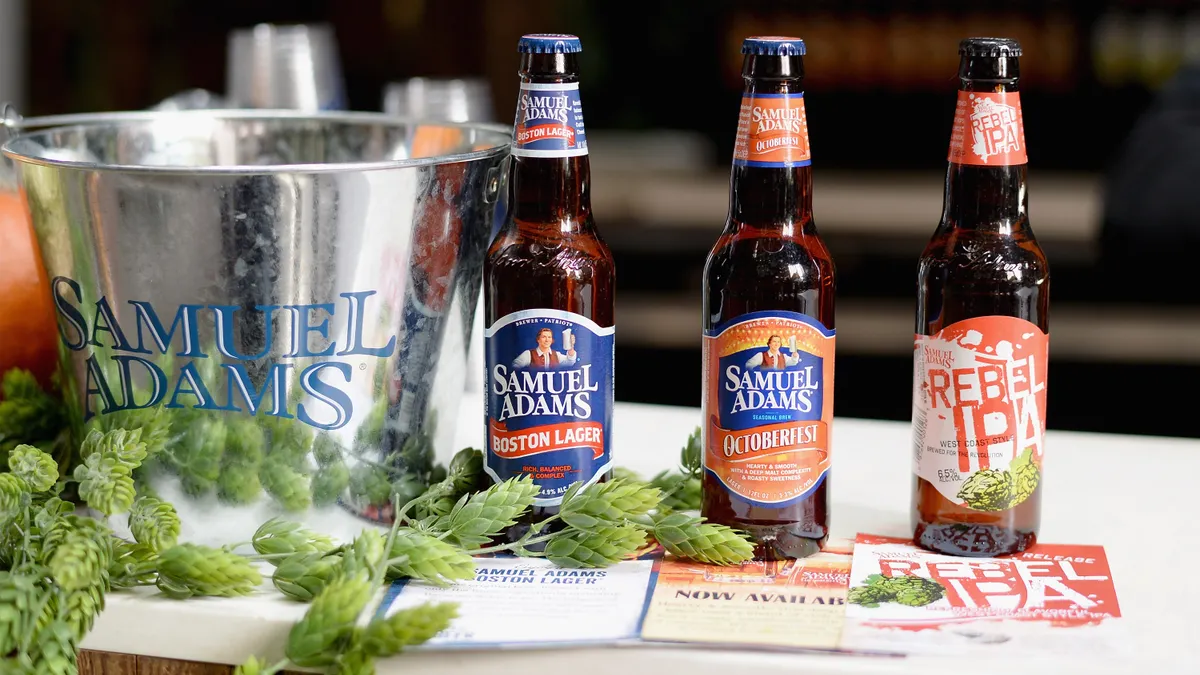
Since founder Jim Koch departed after his first stint as CEO of Boston Beer in 2001 following 17 years in the role, consumer demand for beer has dwindled while hard seltzers, teas and other beverages has infiltrated the alcohol category. This has forced the beverage maker to diversify beyond its signature Sam Adams brew with drinks like Truly, Twisted Tea and Angry Orchard.
Even the beer sector has changed. Boston Beer, which ignited the craft beer boom after its founding in 1984, has seen the category explode and is now joined by thousands of other brewers.
At Hormel, the company last year faced higher costs for beef and other raw ingredients, bird flu that resulted in the culling of tens of thousands of Jennie-O turkeys and a fire at an Arkansas peanut plant that impacted its Skippy butter.
Saunders noted that bringing back a CEO could imply that companies don’t believe they have an executive they feel confident in appointing. Koch told The Wall Street Journal last August that he expects to be in the role until an executive within Boston Beer is deemed ready.
“I don’t anticipate doing this in five years,” Koch said of his interim position. “There are multiple people who are not yet ready, but in a couple of years, one or two of them will be.”
In the case of Hormel, many on Wall Street believe Ettinger, whose roughly 16-month stint is expected to end in October, will eventually hand over the post to Glingo, the company’s president.
Dan McCarthy, an associate professor of marketing at the University of Maryland, said a company might be at a point where it would benefit from a CEO who is especially skilled at one thing, such as growth, restructuring or just running the company. Those skills might be needed only for a period of time to get the company through potential rough patches.
“You want to make sure that you've got the person who's right for the job at that time, given what's going on with the company at that time,” McCarthy noted. “That just might not be the same thing as what happened 15 years ago when that person was originally leading the charge.”