Emerging brands redefine the landscape for food and beverage innovation
Courtesy of Poppi
Note from the editor
For large food companies, it’s often smaller brands that can be the biggest competition.
Fast-growing, independent food brands made up a quarter of growth in the food sector last year, according to Bain & Company. In many cases, these brands are thriving by focusing on clean-label positioning or on-trend ingredients like protein.
Many emerging brands have remained concentrated in the beverage space, where an influx of competition is leading to a proliferation in innovation around functional ingredients. Smaller players are also redefining the category, introducing innovative options like hop water, cactus water or protein sodas.
As food giants struggle with flatlining sales, some are now starting to play catch up with M&A or their own innovation. Many are releasing their own versions of these products or using their deep pockets to buy out the emerging brand.
In this trendline, Food Dive takes a look at how emerging brands across different sectors are using innovation to out perform large CPGs.
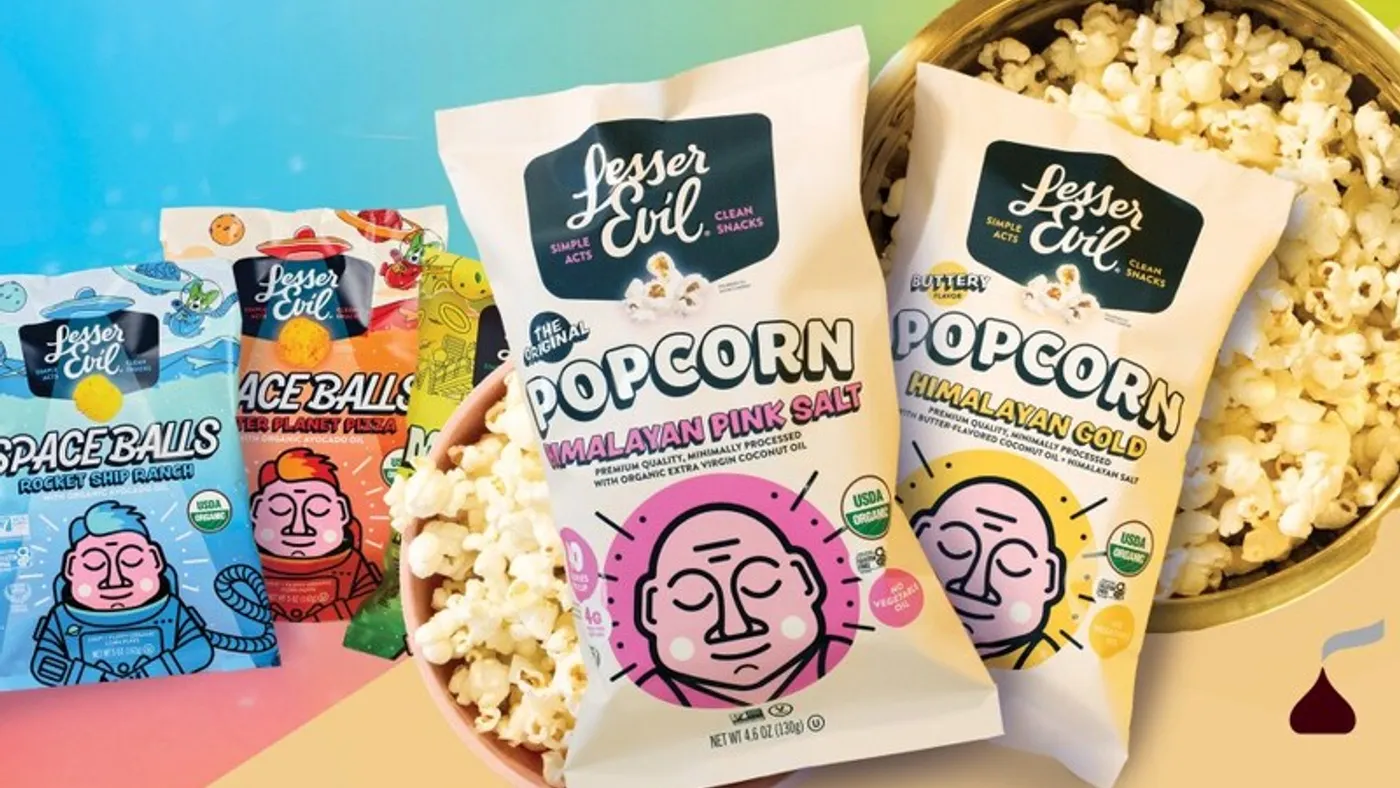
Insurgent brands such as LesserEvil, Chomps and Kodiak drove 25% of growth in the food sector in 2025, according to Bain & Company.
By: Christopher Doering• Published March 5, 2026
Fast-growing, independent food brands such as Kodiak pancakes or Chomps meat sticks made up a quarter of growth in the food sector last year, with the most disruptive products benefiting from consumer demand for clean and natural offerings,according to a study from Bain & Company.
Each year, the management consulting firm tracks what it calls "insurgent brands," or consumer products that have outperformed the market. These brands grow at least 10 times faster than the category average while remaining independent or having been acquired by a large CPG within the past two years.
New insurgents making the list in 2026 include Archer meat snacks and LesserEvil, a maker of better-for-you snacks that was acquired by Hershey in November. Returning insurgents include Conagra Brands’ Fatty meat sticks, Chomps meat sticks, Carbone sauces, Kodiak pancakes and PepsiCo’s Siete, a recent acquisition for the food giant.
The management consulting firm said these brands are thriving by focusing on clean-label positioning or on-trend ingredients like protein. Bain noted that 44% of brands featured natural or organic claims, nearly four in 10 touted high protein and a quarter emphasized elevated or global flavors.
As major food companies struggle to achieve growth, acquiring challenger brands has become a strategic lever to play in new categories and rejuvenate sales. Large CPG companies have been shedding slower, non-core assets while purchasing faster-growing assets with products in trendier areas.
Of the insurgent food brands on Bain's 2026 list, LesserEvil and Bachan's barbecue sauce have been acquired by larger food companies within the past year. Good Culture cottage cheese, another brand on the list, sold a majority stake to private equity firm L Catteron in January.
“In a market where overall growth remains muted, insurgents are increasingly attractive investments for established consumer products players and investors seeking footholds into areas of growth,” Charlotte Apps, executive vice president of Bain’s consumer products practice, said in a statement.
A similar pattern appeared in both non-alcoholic and alcoholic beverages. Last year alone, 13% of growth in nonalcoholic beverages came from insurgent brands, Bain said.
The firm’s insurgent list in the nonalcoholic category included prebiotic soda Poppi, Ghost energy drink and nonalcoholic carbonated mixer Fever-Tree. All three have been acquisition targets. PepsiCopurchased Poppifor $2 billion in 2025, whileKeurig Dr Pepper snapped up Ghostfor more than $1 billion a year earlier. Meanwhile, Molson Coors took a minority stake in Fever-Tree in January 2025.
Article top image credit: Courtesy of Hershey
Celebrity-studded Caliwater bets cactus is next big wave in hydration
Despite a roster of investors including Demi Lovato and Benson Boone, the brand hopes to scale by focusing its messaging around taste.
By: Laurel Deppen• Published March 6, 2026• Updated March 9, 2026
Anaheim, Calif. — Celebrity-backed Caliwater was founded with a simple idea, according to actor and co-founder Oliver Trevena: “Why coconut when you could cactus?”
Trevena, who said he was a big coconut water drinker, co-founded Caliwater in 2021 after discovering an alternative that he called “Mother Nature’s super fruit,” the prickly pear cactus. Caliwater is positioned as an alternative to coconut water and sports drinks with added electrolytes, less sugar and fewer calories.
While celebrity-backed beverages are nothing new, especially within the crowded beverage industry where brands use partnerships to stand out, Caliwater is uniquely stacked with star power.
Actress Vanessa Hudgens is another co-founder, and the brand launched a blood orange flavor endorsed by musician Demi Lovato. Other celebrity investors include Glen Powell, Gerard Butler and Cody Bellinger.
Earlier this week, Caliwater added musician Benson Boone as an investor and partner. The brand has plans for Boone’s involvement, but didn’t provide specifics.
Despite the long list of celebrity backers, Caliwater highlights its taste more than anything. As a consumer of better-for-you beverages, Trevena joked that he might say he liked kombucha but “if I was put on a lie detector machine…it would probably beep.” Caliwater is meant to be the antithesis of that experience.
The hydration category has made a bigger splash in recent years as more consumers turn to the beverages for more than just sports. Hydration drinks like coconut water, which present themselves as a better-for-you alternative, have especially benefited with Vita Coco for example aiming to cross the $1 billion sales threshold in the next five years.
“Hydration and health is a massive factor for whatever country you live in, but especially in the U.S.,” Trevena, who is from the U.K., said at the Natural Products Expo West conference in Anaheim. “If you can drink something that you enjoy, and at the same time get health benefits from it, it’s kind of a win-win.”
While prickly pear is the base of all Caliwater’s drinks, the brand offers ginger and lime, pineapple and watermelon flavors. In addition to promoting its health and hydration benefits, Caliwater also wants to be positioned as a mixer for alcoholic beverages or mocktails.
The company recently launched in kids pouches as well, which Trevena said was important because “kids are just brutally honest. They can’t be influenced by [a] celebrity.”
The beverage is available in the U.S. and Mexico, and Trevena said the company is eyeing Canada for its next expansion.
As Caliwater looks to scale, it's also tapping its first CEO in Blair Owens, former chief executive of flavored water upstart Hint. Trevena said in a statement that Owens, who also held leadership and marketing roles at Coca-Cola and Monster, “understands how to scale brands with intention, build high-performing teams, and execute with discipline.”
Though Trevena’s resume includes acting in several movies, pivoting to something new like a beverage company provides a welcome challenge.
“The authenticity of [Caliwater] was there, [and] you know, it’s a challenge,” Trevena said. “We’ve created something that stands alone, and it’s not a quick fix. We’re not trying to win immediately.”
Article top image credit: Courtesy of Caliwater
Sponsored
How disruptor brands turn trial into durable growth
Disruptor CPG brands have gotten very good at getting noticed.
They’re entering established categories with sharper positioning, new formats and products that respond quickly to changing consumer preferences. Shoppers are clearly willing to give disruptor brands a chance. Shoppers are clearly willing to give disruptor brands a chance. In the last 18 months, 52.3% of Fetch users purchased one, a trend visible across the 13M+ receipts Fetch sees every day.
But getting consumers to try something new and building a brand they buy for years are two very different challenges.
For emerging brands, the next phase of growth is less about proving there’s demand and more about turning that demand into scale. That means getting into more households, converting trial into repeat behavior and making limited budgets work harder.
The growth equation changes as brands scale
Early-stage growth can come from a concentrated group of enthusiastic consumers. Those buyers discover the product, talk about it and help establish credibility.
Eventually, though, the math changes.
To keep growing, brands have to reach beyond the consumers already predisposed to try something new. They need to find category buyers who haven’t heard of them, competitive buyers with established routines and households that may need a compelling reason to change what they put in their carts.
That makes household penetration increasingly important. The challenge becomes less about generating more attention, but systematically creating more relevant buyers.
Trial is valuable. Retention builds a brand.
Winning the first purchase is hard. Winning the second has become even more important.
A consumer may initially choose an emerging brand because the packaging caught their attention, someone recommended it or they were curious enough to give it a shot. But novelty alone doesn’t create a habit.
The brands that successfully graduate from challenger to category mainstay have to give consumers reasons to return. Acquisition and retention can’t operate as completely separate strategies: every new household represents an opportunity to build a longer-term relationship.
That requires marketers to look beyond the launch spike and ask a harder question: Are the consumers we worked so hard to acquire actually coming back?
Emerging brands can’t afford to optimize for the wrong signals
Scale introduces another challenge, deciding where the next marketing dollar gets put to use.
For brands with finite budgets, activity and growth aren’t necessarily the same thing. Impressions, clicks, engagement and cultural buzz can indicate that a campaign is getting attention, but they don’t necessarily translate to trial.
That distinction becomes increasingly important as brands expand distribution, enter new markets and compete for larger marketing budgets.
Purchase-based measurement can help connect marketing efforts with real purchase behavior and distinguish between consumers who happened to see a campaign and incremental buyers whose behavior changed because of it.
The opportunity is turning disruption into durability
The good news is that emerging brands don’t need the scale of legacy competitors to start building more sophisticated growth strategies.
They need clarity around three things:
Who they need to acquire
How they’ll encourage those consumers to return
How they’ll prove that their investment generated incremental growth
That’s where platforms built around real purchase behavior can become valuable. Fetch, for example, helps brands acquire and retain consumers and ties outcomes back to real purchases through receipt-based measurement.
Among the disruptor brands included in Fetch's analysis of the past 18 months, Fetch drives an average 37% lift in household penetration and 18% unit lift.
But the bigger lesson extends beyond any one platform or campaign.
Emerging brands have already proven they can create excitement, challenge incumbents and convince consumers to try something different. The brands that define the CPG industry will be the ones that figure out what comes after that first purchase.
Disruption gets you noticed. Durability is what makes you a household name.
Article top image credit: Igor Suka//E+ via Getty Images
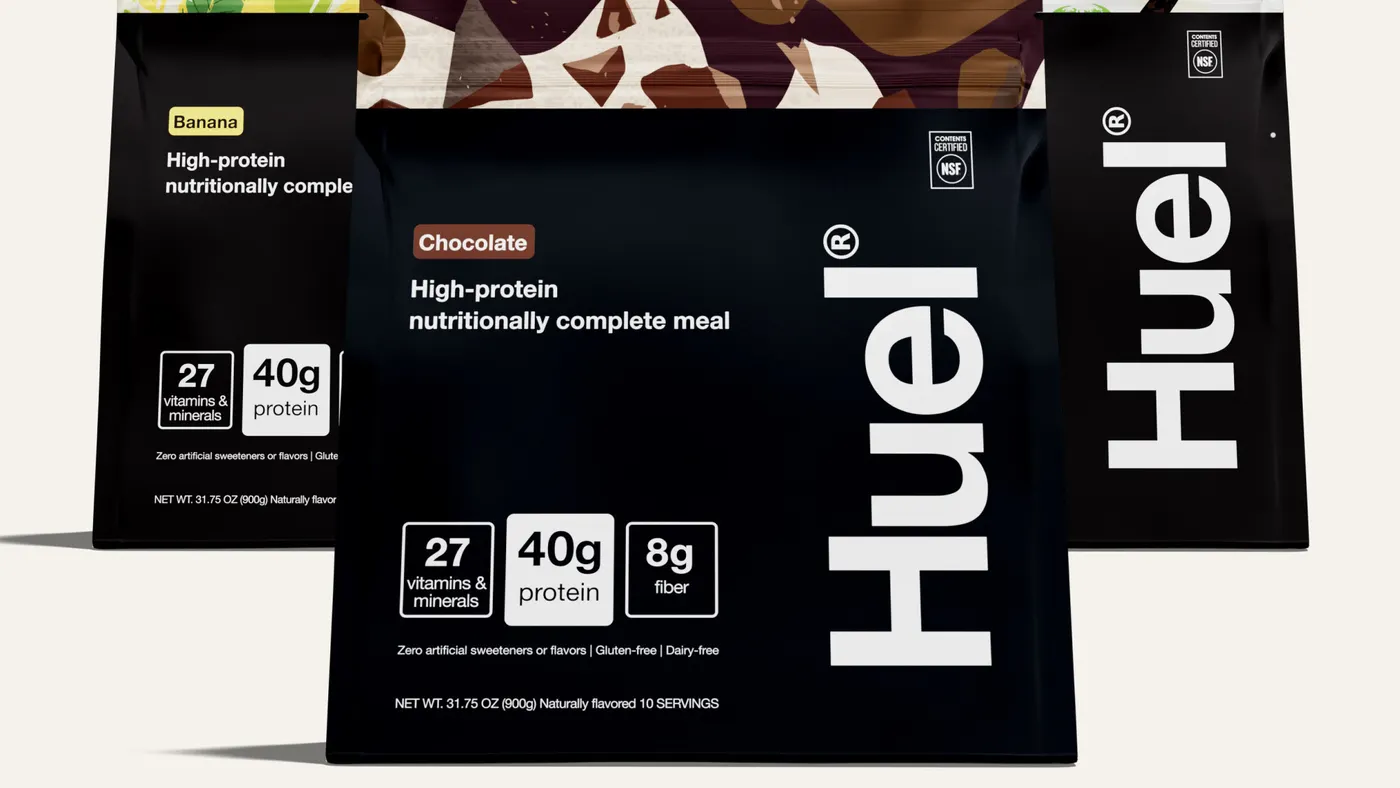
Danone to buy protein and fiber food maker Huel
The Oikos parent is purchasing the powders and ready-to-drink beverage producer for a reported $1.2 billion, enhancing its presence in functional and complete nutrition.
Danone touted Huel’s “best-in-class” digital execution, direct-to-consumer business and a consumer base in the U.K., Europe and the U.S. The transaction is subject to customary closing conditions, including regulatory approval.
Danone brands, including low-sugar Too Good and protein-rich Oikos, have been big winners among consumers looking to eat healthier and those on GLP-1s for weight loss. The deal for Huel expands Danone's portfolio of functional and complete nutrition offerings.
Dive Insight:
Danone's purchase of Huel further positions the yogurt giant's portfolio to cater to consumers looking for better-for-you foods and specific nutrients that advance performance or health goals.
“Most people don't get enough protein, fibre, or the right nutrients. That's the problem Huel exists to solve,” James McMaster, Huel’s CEO, said in a statement.
McMaster said Danone will provide infrastructure, distribution and R&D capabilities to allow 11-year-old Huel to enter new markets and cater to additional consumers as demand “for convenient, complete nutrition continues to grow.”
In addition to boosting their intake of protein, fiber and other nutrients, time-constrained consumers have been flocking to portable, more convenient items such asOikos Fusion. Huel’s powders, meal packets and cups and high-protein shakes fit squarely in this area.
Expanding into ready-to-drink meals also further caters to consumers on GLP-1s, who have suppressed appetites but still need to ensure they receive their complete nutrients.
“What they have achieved in the fast-growing Complete Nutrition space fully resonates with Danone’s mission of delivering health through food,” said Antoine de Saint-Affrique, Danone’s CEO.
Article top image credit: Courtesy of Huel
Challenger food brands are standing out despite fewer marketing swings
Dan Eisenberg, CMO at Blue Chip, discusses how brands such as Emerald Nuts and Bob’s Red Mill compete against corporate giants.
By: Danielle McLean• Published June 30, 2026• Updated June 30, 2026
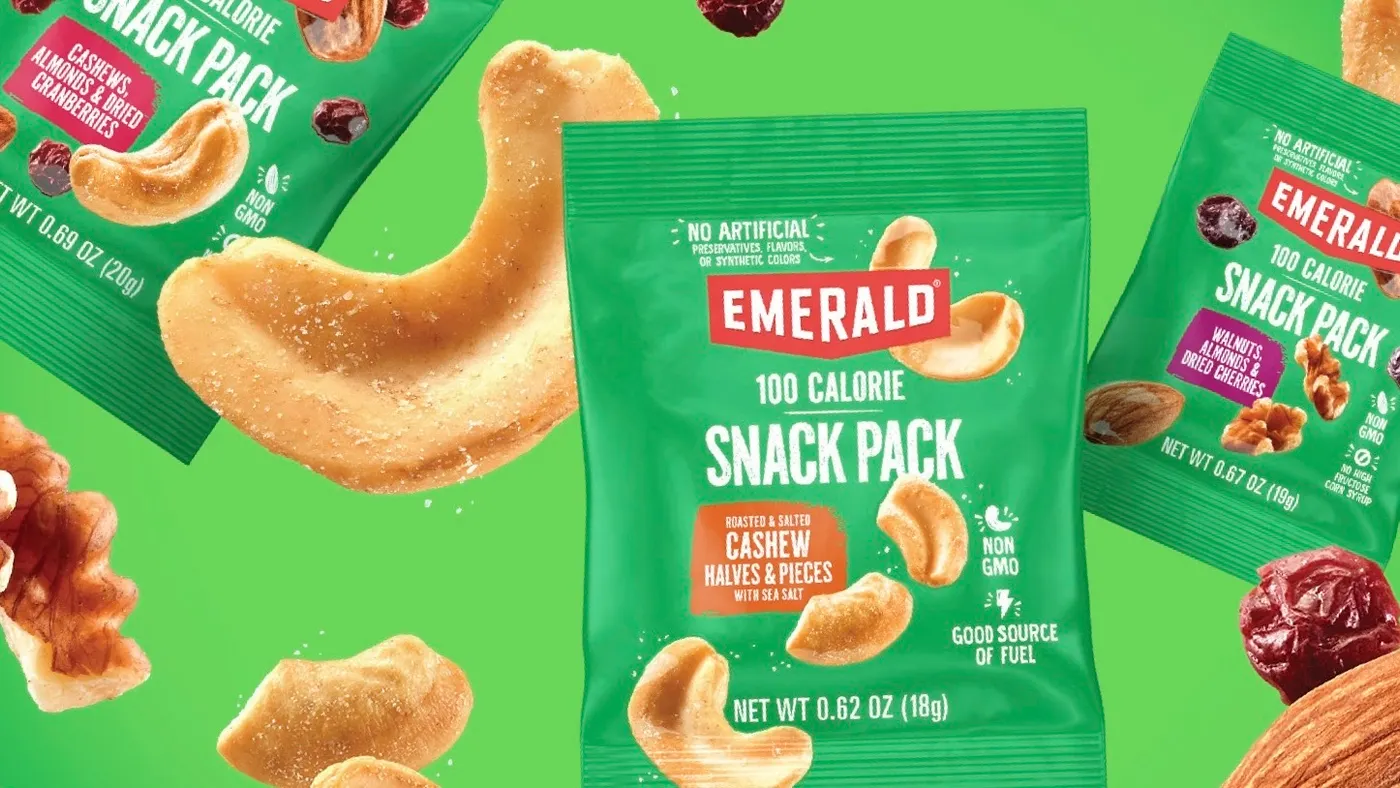
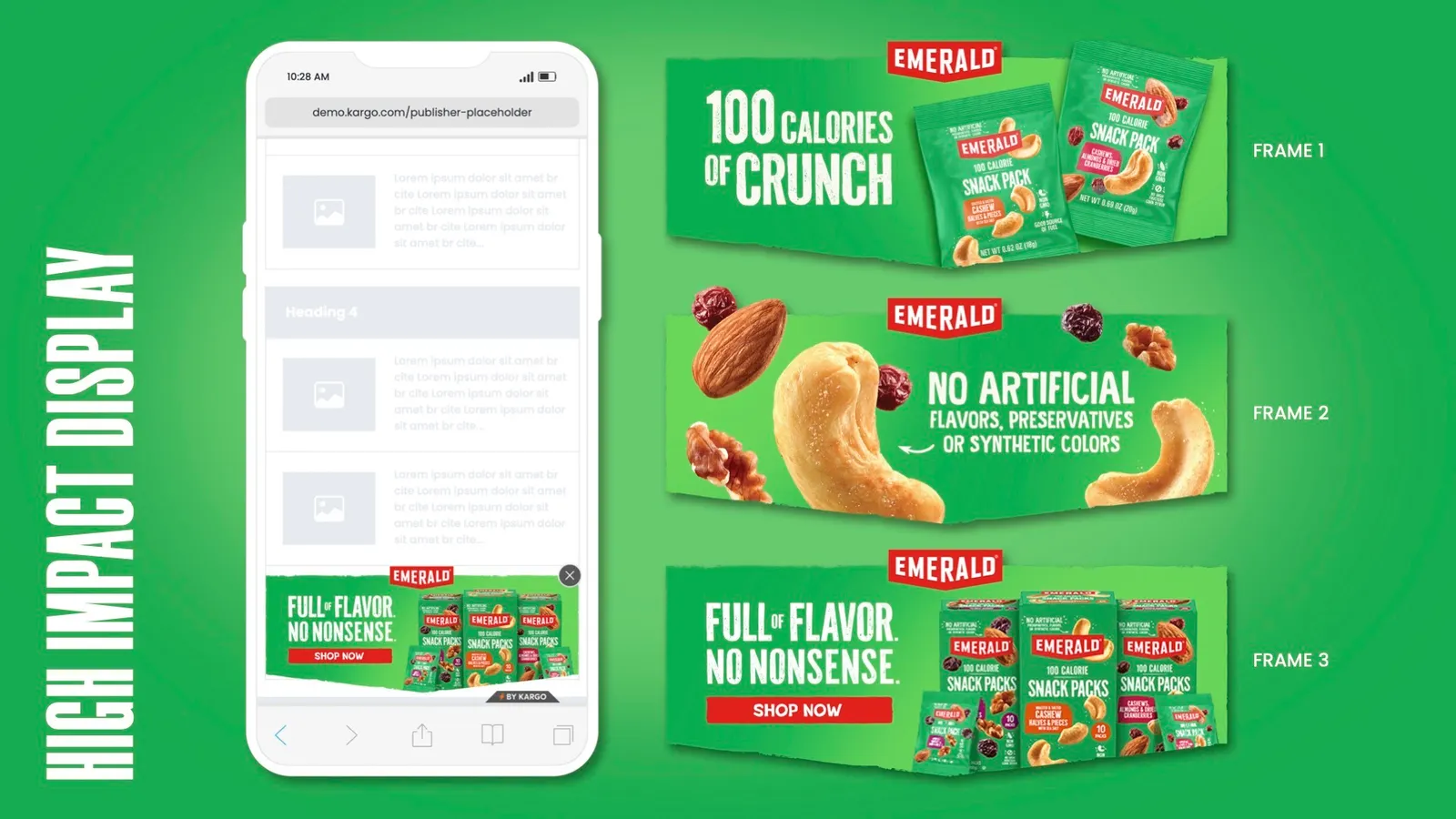
Last year, Emerald Nuts launched its first ad campaign in years that included a 30-second national TV ad filmed at a baseball stadium in Texas. A pair of Western-clad vocalists sang “Take Me Out to the Ball Game” during the seventh inning stretch. The singer eating Emerald Nuts got the song right, while the other, eating generic nuts, sang nonsensical lyrics to a confused crowd.
The ad compared the “nonsense in life” to the nonsense in the salty nuts category, and that “Emerald was coming in over the top of that,” said Dan Eisenberg, CMO at Blue Chip, a Chicago-based independent brand commerce agency.
Emerald is among the packaged goods challenger brands that Blue Chip has collaborated with over the years. These are mid-market and smaller brands with limited marketing budgets, but that have to compete against large corporate-owned or established brands with deeper pockets.
For challenger brands especially, it's crucial that the precious money spent on marketing builds awareness in a way that differentiates a brand from its competitors, while using research and data to zero in on the specific markets and retailers that are a strategic fit. Every marketing dollar spent needs to do “double duty” — building up the brand and driving the sale at the same time, said Eisenberg.
Challenger brands are inherently newer to the marketplace so it’s important that they build awareness, Eisenberg explained. But they have to make sure that awareness building and storytelling is connected to conversion, retail media, trade marketing and shopper marketing.
“Challenger brands specifically cannot afford to have separate branded performance strategies. There's way too much at stake,” he said.
A ‘Nonsense’ sales story
Emerald, which competes with Planters and Diamond, was purchased by Campbell Soup in 2018 — part of a $4.9 billion deal to acquire salty snack maker Snyder’s-Lance — before being sold off in 2023 to private label CPG manufacturer Flagstone Foods.
The brand was “kind of languishing” at Campbell, but essentially relaunched to the marketplace after being sold to Flagstone, said Eisenberg. That’s when Blue Chip was hired to lead Emerald’s brand, media, retail and marketing work.
Blue Chip conducted an assessment of the salty nuts category and found its competitors were selling low-quality products with a lot of fillers or “junk,” per Eisenberg. Emerald set about trying to tap into that white space by investing in new production capabilities and promising high-quality nuts and flavor.
This was the message that became the center of “Nonsense,” the brand’s first consumer campaign in years and which poked fun at competitors in the category, said Eisenberg.
Emerald Nuts' ads compare the nonsense in life to the nonsense in the salty nuts category.
Courtesy of Blue Chip agency
“It wasn't just humor for humor's sake, it was humor with a real strategic reason and a clear point of difference in the category,” he said.
The media strategy included paid social media, such as TikTok and retail media for key retailers such as Walmart, Kroger and Publix, according to information shared by the company in an email. The effort ultimately connected with younger audiences — driving engagement among millennial shoppers by 11% and boosting new-to-brand purchases by 30%, the company stated.
It also gave Emerald’s sales team a new sales story that they approached retailers with — allowing them to rebuild the brand’s retailer relationships that had languished under Campbell, said Eisenberg.
Growing household penetration
Portland, Oregon-based Bob’s Red Mill, which launched a new brand look this year, has evolved into a national better-for-you food brand whose products compete with large, well-established players including Quaker Oats, a PepsiCo subsidiary, in the oatmeal space, and other challenger brands, such as King Arthur Baking in the flour space.
Blue Chip took on Bob’s integrated media and shopper marketing work and campaigns five years ago — working alongside the company’s marketing, sales and company leadership teams, said Eisenberg.
That led to an ad campaign that included its “Start with the Best Oats” tagline and was featured in digital and social media, through influencers, and in shopper marketing.
Blue Chip consolidated Bob’s media and shopper marketing investments into a cohesive strategy and launched full-funnel campaigns, said Eisenberg.
Bob’s had previously placed a larger emphasis on lower funnel, Eisenberg said. But, with its products now available in the Midwest, Mid-Atlantic, and Southeast of the U.S., it needed to reach new households, he said.
Blue Chip’s proprietary tool called Market Match, allowed the firm to algorithmically score the markets and designated market areas, where Bob’s they had distribution, and further prioritize where to invest its limited marketing dollars, Eisenberg said. The firm used data to analyze growth and secondary markets — figuring out where consumer look-alike audiences were deepest, where the distribution was going to be strongest, and where they were, or were not, seeing competitive activity, he said.
The campaign was also grounded in real research and data that showed the brand offered a superior experience, said Eisenberg.
The campaign helped Bob’s achieve significant growth in household penetration and dollar sales over the past five years, said Eisenberg. That includes a record-breaking Q4 in 2025 in which the brand saw its first million-dollar week at Walmart,according to information shared by the company in an email.
“The business has been very strong and a big part of that has been growing household penetration,” said Eisenberg.
“Fewer, bigger, better”
Challenger brands such as Bob’s Red Mill “don’t have the luxury of being everything to everyone,” said Eisenberg. But that constraint can also play to the challenger brand’s advantage, since the mindset can lead to strategic focus.
Blue Chip advises its clients to follow an approach of: “Fewer, bigger, better.” The firm’s clients make disciplined and precise choices around their consumer audience, their markets and the designated market areas where they are directing their media spend, he said. They also make decisions around the types of media channels they want to be in and retailers they want to support, he said.
“We're really focusing on high impact opportunities,” said Eisenberg.
Correction: A previous version of this article related a quote from Blue Chip’s executive to the wrong brand and got the order of words incorrect in another quote. The article has been updated to address these issues.
Article top image credit: Courtesy of Blue Chip agency
Hop water to fill wellness niche in nonalcoholic beer
Brewers are playing up the sparkling beverage’s better-for-you attributes to appeal to a wide variety of consumers.
By: Laurel Deppen• Published Dec. 4, 2025
Hop water has carved out a space for itself in the nonalcoholic beer category, but to expand further, the segment is taking a page out of the better-for-you beverage playbook.
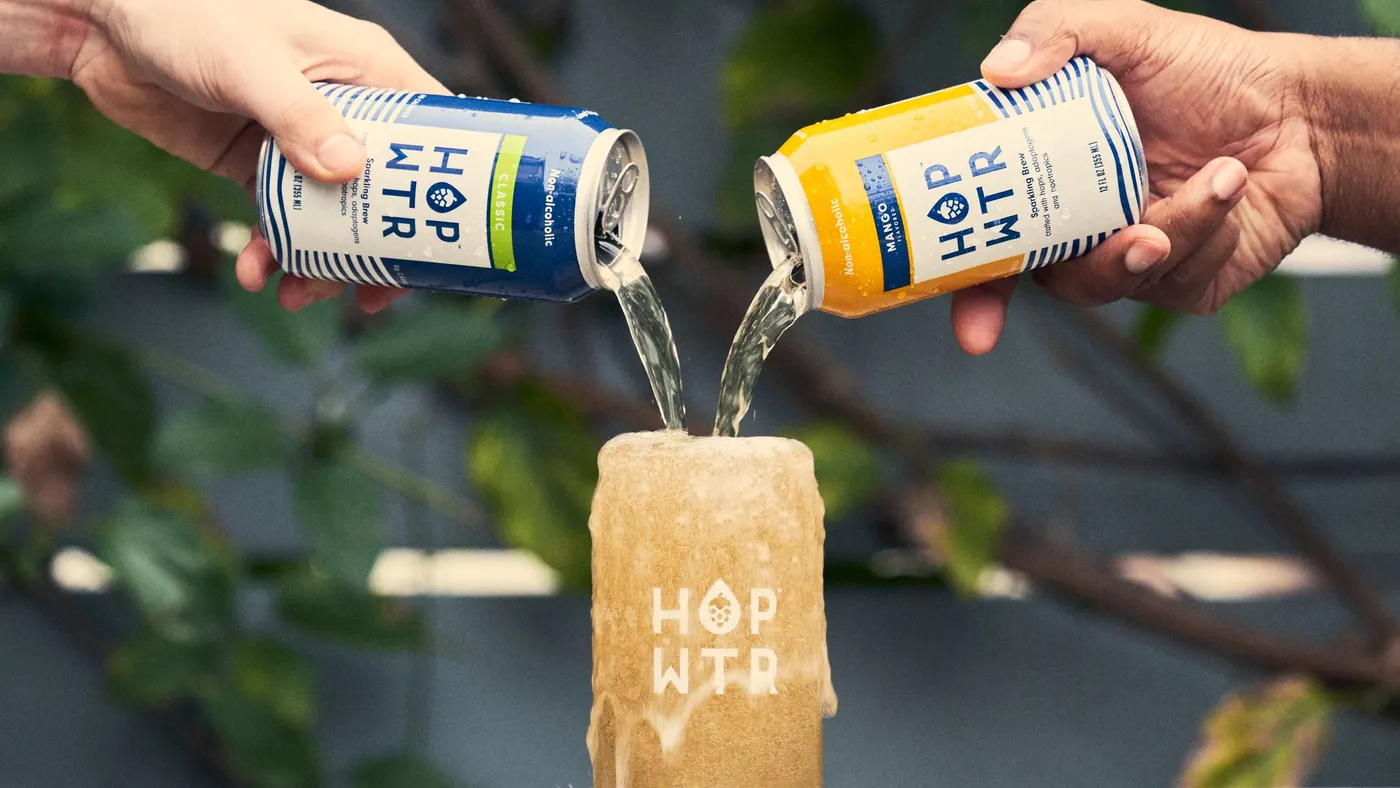
Sometimes called the “LaCroix of beer,” hop water is a sparkling water flavored with hops, the flowers that give beer its bitterness, taste and aroma. The beverage was first introduced in 2014 by home brewer Paul Tecker, and became one of the first players in the nonalcoholic beer space that began to take off a few years later.
But despite being a pioneer in the nonalcoholic sector, hop water has still struggled to take off — even as the nonalcoholic category overall explodes. Hop water generates about $28.5 million in U.S. sales, according to data from NielsenIQ, a small percentage of the nonalcoholic segment, which is set to reach $1 billion by the end of this year.
Sales of nonalcoholic beer grew 18% year over year during the 52-week period that ended Oct. 25, according to NIQ data, while hop water experienced a 7.3% decline.
However, experts agree there is still potential for the space, especially amid the rise of functional beverages with better-for-you attributes like no sugar or low carbs.As alcohol sales have dwindled, beverages with added functional properties have seen increased demand, including sodas with added prebiotics and energy drinks with added vitamins.
That could play to hop water's advantage. Unlike nonalcoholic beer, hop water typically has no calories, carbs, sugar or gluten.
Kaleigh Theriault, NIQ’s director of beverage alcohol thought leadership, said hop water's slowdown represented a maturing phase for the product after it saw curiosity-driven expansion when it first launched. But she still sees potential for a resurgence due to the drink's better-for-you attributes.
“Despite current declines, Hop Water’s premium positioning and crossover appeal to health-conscious consumers suggest potential for renewed growth as brands innovate in flavor, functionality, and distribution,” Theriault said.
The hop water segment has also attempted to carve out a place for itself in the THC-infused beverage category, with offerings from Hybrid, Lagunitas, Hop Dreams Sweet Dreams, and some regional players. This segment could be thwarted, however, by recent legislation that limits the amount of THC, the main psychoactive ingredient in marijuana, in products.
Brewer Sierra Nevada launched its line of hop waters, dubbed Hop Splash, in response to the national trend in alcohol shifting to moderation in 2022. The company was looking to launch a product that still creates the feeling of a beer that also could serve as a healthier alternative to soda, said Ellie Preslar, Sierra Nevada's chief commercial officer.
Moving forward, hop water makers are looking to expand their consumer base beyond the nonalcoholic beer drinkers and cater to growing demands for health and wellness. Sierra Nevada’s hop water, which makes up just 1% of the brewer's business, has seen the most success in wellness-focused spaces, including natural grocery stores.
“I think it’s just because of what they’re looking for from an ingredient and quality perspective,” Preslar said. “It really seems to fit. That’s where these products have taken off more than anywhere else.”
Hopwtr, a company founded in 2020 that exclusively sells the beverage, is leaning its marketing heavily into promoting itself as a functional beverage. Jordan Bass, cofounder and CEO of the company, said one of its key differentiators is adding mood-boosting adaptogens and nootropics to its content.
Appealing to both beer consumers and wellness consumers makes the market a bit wider, Bass said. But one of the biggest challenges faced by the hop water segment is that many consumers don’t know what it is.
To build excitement, producers are focused on new flavors and innovation, a similar tactic to what brewers did to build up the craft beer segment. Sierra Nevada sells hop water in a multipack with several different flavors, according to Preslar.
New flavor innovation has also been core to Hopwtr’s approach. It recently released a combined iced tea and lemonade flavor, which was driven by a growth in hard teas, and a spiced apple seasonal offering.
“Consumers always report flavor as one of their top purchase drivers,” Bass said. “We felt it was really important to have a great array of flavors.”
Article top image credit: Courtesy of Hop Wtr
Hydration for her: Coconut water brand Greater Than pivots to reach more women
The brand is unveiling a new formula and look as it aims to shake up the traditional hydration category.
By: Laurel Deppen• Published March 17, 2026
Coconut water company Greater Than is relaunching the brand as a women's hydration beverage.
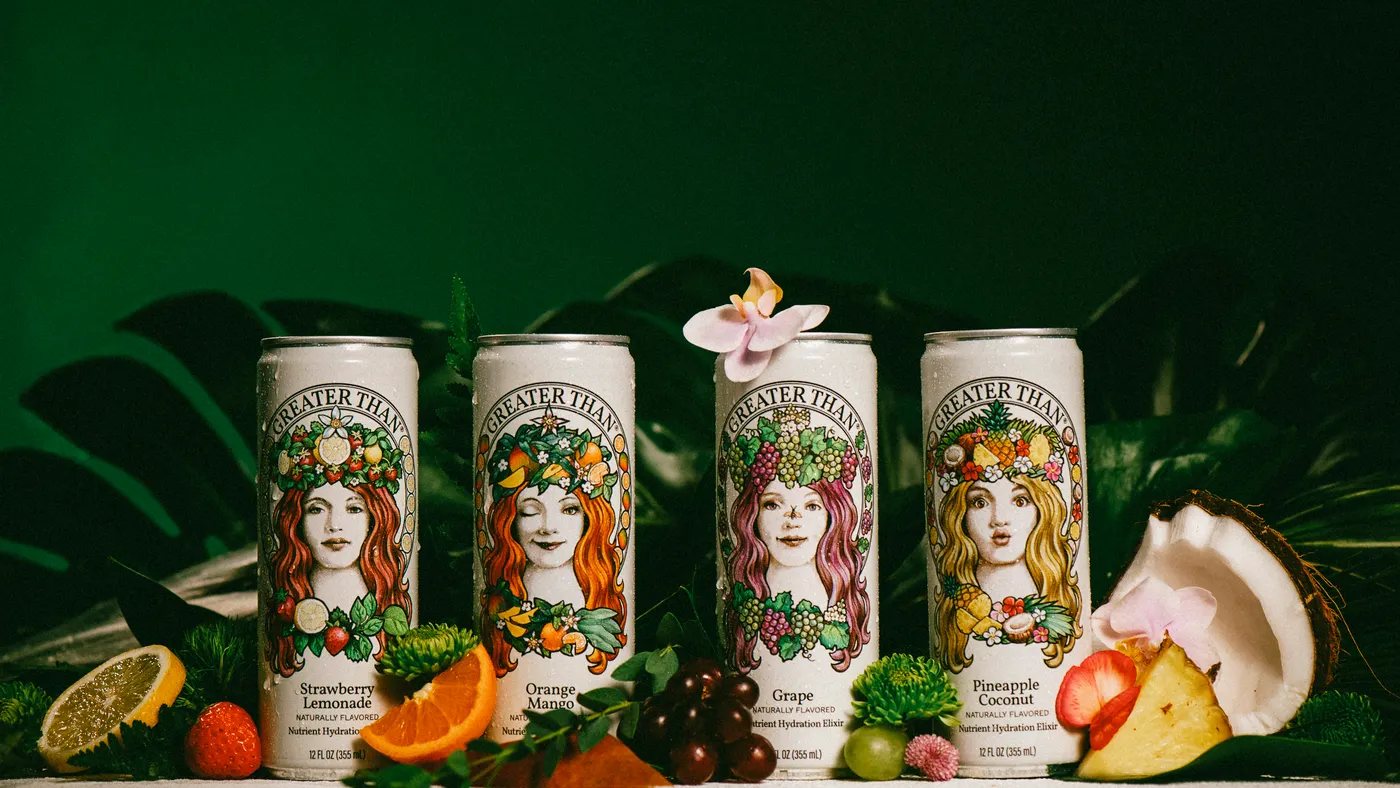
The company, founded in 2010, was initially designed as a sports drink free from synthetic dyes, artificial flavors or sweeteners. Last month, it announced a comprehensive rebrand with a new recipe and updated packaging to become a women’s hydration “elixir.”
Greater Than’s new product is still coconut water-based and includes three servings of fruits and vegetables for added fiber, plus vitamins A, C and E. The formulation also uses 85% less added sugar than traditional hydration beverages, per the company. Flavors include strawberry lemonade, orange mango, pineapple coconut and grape.
The broader hydration category has been shaped by male physiology, which doesn’t address women’s specific health needs, according to Brianna Harris, a registered dietitian and Greater Than’s director of research development and education. The brand is working to fill a gap in women’s diets, which is why adding fiber to the beverage was so crucial.
“We also saw a lot of trends in the hydration space, and people want more out of their beverages,” Harris said. “Hydration alone is not cutting it.”
Women are increasingly driving demand for better-for-you beverages such as energy drinks and sodas. Brands including Poppi and Alani Nu have found success through formulations that speak to women's specific health needs.
Greater Than executives think the brand’s designation as a beverage strictly “for her” will allow it to stand out against its competitors in hydration, where there are fewer options designed for women. The brand has had a cult following among breastfeeding mothers since 2019 for its ability to assist with lactation.
The refreshed brand will look beyond new mothers, however, to support women throughout their life and for “phases and stages” such as puberty, pregnancy and menopause, said Heather Howell, president and CEO of Greater Than.
In the future, the company plans to test new flavors and a sparkling option. It will also prioritize launching new beverages focused on supporting women through different life stages based on emerging research.
“When you listen to women, you create movements, and you create categories,” Howell said.
Howell, who worked at Brown-Forman as head of global innovation for Jack Daniel’s, said too many brands try to reach women with fun packaging instead of designing a product that speaks to a consumer's needs.
“You do not have to color Jack Daniel’s pink in order to get women to purchase it,” Howell said. “You just have to talk to them.”
Article top image credit: Courtesy of Greater Than
How emerging brands are disrupting the F&B industry
Emerging brands such as Poppi, Simple Mills and Mike’s Hot Honey have transformed into household names, stealing market share from traditional CPGs. New brands are successfully tapping into the growing consumer demand for healthier food that doesn’t sacrifice taste or convenience, forcing major food giants with stagnant sales to play catch-up.
included in this trendline
From restaurant to retail: How Michelin-starred brands are infiltrating the grocery store
Olipop valued at nearly $2B following latest funding round
Coca-Cola enters trendy prebiotic soda market with Simply Pop
Our Trendlines go deep on the biggest trends. These special reports, produced by our team of award-winning journalists, help business leaders understand how their industries are changing.